Are you a looking for a unique and engaging activity to share with your dog? Look no further than mantrailing! This exciting and rewarding activity offers numerous benefits for both you and your dog. Unfortunately, there are some misconceptions floating around that may discourage potential enthusiasts. Fear not! In this blog, we will delve into the amazing benefits of mantrailing while debunking five common myths, including the notion that only certain breeds can excel in this activity.
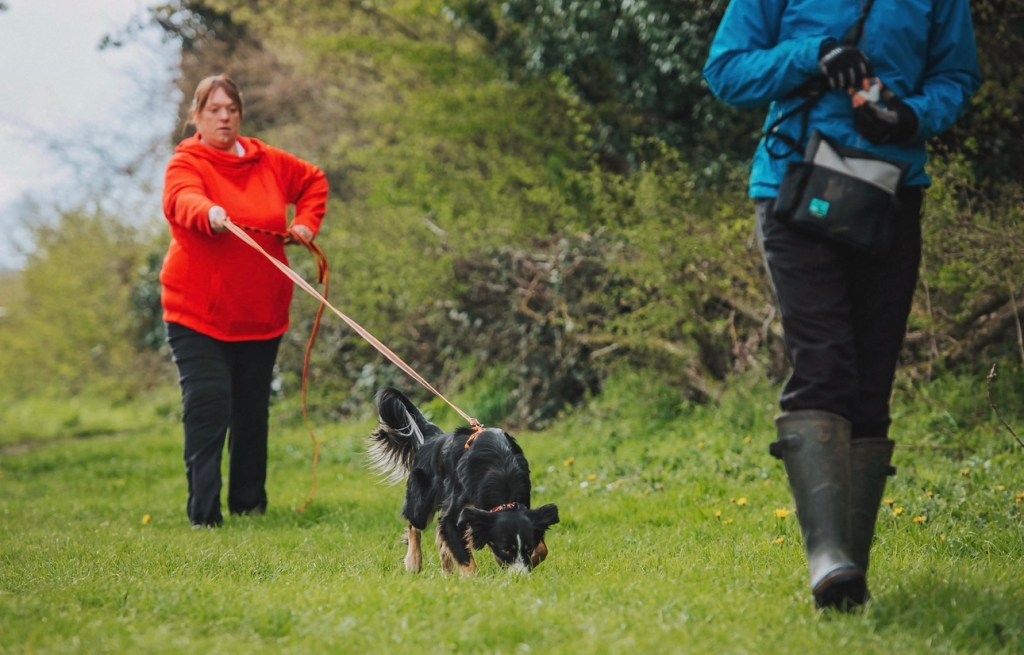
Maya hot on the heels of her trail layer
Myth: Only certain breeds can trail. One of the most persistent myths about mantrailing is that only specific breeds possess the necessary skills to participate. In reality, any dog, regardless of breed or size, can learn to be a good mantrailer. While certain breeds may have natural instincts that make them excel in scent work, any dog can be trained to enjoy and succeed in mantrailing. It’s all about patience, consistency, and building a strong bond with your dog.
Myth: Mantrailing is only for highly energetic dogs. Another misconception is that only high-energy dogs can benefit from mantrailing. While it’s true that energetic dogs often enjoy this activity, it can also be a great outlet for dogs with lower energy levels. Mantrailing provides mental stimulation, encourages problem-solving skills, and promotes overall well-being. It’s a fantastic way to engage and challenge dogs of all energy levels while strengthening the bond between you and your pet.
Myth: Mantrailing is too complicated to learn. Some may think that mantrailing is a complex and challenging activity to teach their pets. However, with the right approach and guidance, mantrailing can be taught to dogs of all ages and skill levels. We will help you understand the basics, including teaching your dog to follow a specific scent, differentiate between scents, and work collaboratively with you. The key is to start with simple exercises and gradually build up skills through positive reinforcement and consistent practice.
Myth: Mantrailing is only for professional search and rescue dogs. While mantrailing is commonly associated with search and rescue work, it’s essential to recognise that this activity can also be enjoyed recreationally. Participating in mantrailing provides mental stimulation, offers an opportunity for dogs to utilise their natural instincts, and encourages physical exercise.
Myth: Mantrailing is time-consuming and requires extensive equipment. Contrary to popular belief, mantrailing can be adapted to fit your lifestyle. You don’t need elaborate equipment or hours of training sessions to enjoy this activity. Even short, regular sessions can provide significant benefits for your pet. With a few essential items like a long leash, harness, you can start your mantrailing adventure in no time. It’s a flexible activity that can be tailored to your schedule and preferences.
Mantrailing is a fantastic activity that offers numerous benefits for both you and your dog. By debunking these common myths, we hope to inspire pet owners to give mantrailing a try, regardless of their dog’s breed or energy level. The joy, mental stimulation, and strengthened bond you’ll experience with your pet are well worth the effort. So, grab your lead, follow the scent, and embark on an exciting mantrailing journey with your dog!
Check out the Doghampton Facebook page to start your journey.
I peek out the front door to check on my
dog, who is sunning himself in his favourite spot in the sun. He is lying on an
old moving trolley, since repurposed to give him a boost up to the sunrays,
which don’t reach the ground at this time of morning. As I stick my head out
the door, he lifts his nose, and I can see his nostrils gently flare in and out
as he recognizes I am close. He does not see me with his eyes, as they are
squinted shut due to the sun, but he sees me with his nose.
There are many more examples of my dog
using his nose to see. When I return from the shops, and we greet
enthusiastically, my human tendency is to reach out and touch to say hello, but
he ducks away, preferring to sniff my hands first to see where I have been. (If
you have not already read about the human as opposed to canine perspective of
greeting, it is worth reading ‘How
do you greet a dog politely’). When I return from volunteering at
the dog shelter, he sniffs my shoes and clothes carefully. I get the full pat
down with the nose. If I offer him something, whether it is an object or food,
he does not use his eyes to examine the item further; he sniffs it.
On one occasion, when out on a walk with my
dog, he stopped, hesitant to go further. I surveyed the pavement ahead. It
seemed clear. I thought he was being overly sensitive and encouraged him to
continue. As we passed the parked cars ahead, hiding behind the wheel of the
last car was a cat. I felt very foolish. My dog was right – there was something
ahead! He had seen it with his nose. I should have listened. Being human, I had
immediately dismissed what I could not see with my eyes. On another occasion,
he started sniffing the ground very attentively, seemingly following a trail
back and forth, as he narrowed in on the direction of the scent trail. Looking
ahead to see what had taken his interest, it was easy for me to quickly spot a
scattering of nacho chips that had been discarded on the pavement. This time my
eyesight won out against my dog’s nose, and I was able to divert him away.
Even
with these simple observations, it is apparent how often my dog uses his nose
and scent to make sense of and navigate his environment.
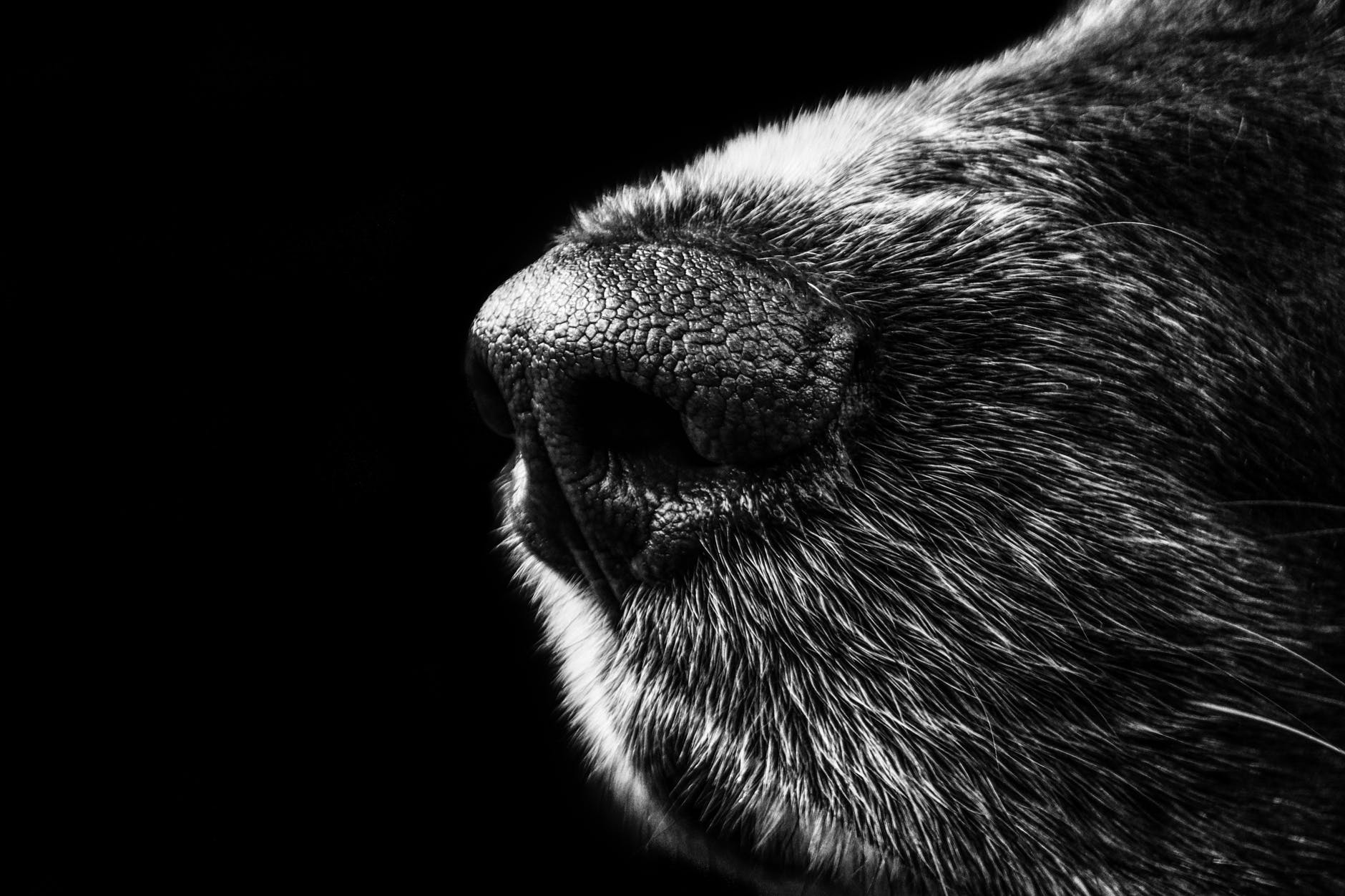
It is understandable why the use of
olfaction may be the predominant sense for dogs. It is estimated that dogs have
300 million olfactory receptor cells; in comparison humans have about 5
million. Dogs have the ability of smelling with each nostril on an individual
basis, allowing them to distinguish the direction of the scent. The slits on
the side of the nose allow for the old air to exit at the same time as the dog
is breathing in new air through the nostrils, allowing the dog to take in scent
continuously. The air is separated and passes through an area at the back of
the nose that has a labyrinth of scroll-like bony structures called turbinates.
The air is filtered through the turbinates for olfaction, while some of the air
follows a separate route down the pharynx for respiration. The air that humans
take in for respiration and scent is not separated, going in and out with the
air that we smell. Additionally, dogs have a secondary olfactory organ called
the vomeronasal
organ that allows dogs to detect pheromones and non-volatile
chemicals. There are times where you can spot the dog using his vomeronasal
organ, as he will display a tonguing
response. The dog may chatter his teeth or drool a bit at the mouth
as he deciphers the components of the scent. To interpret all this information,
a larger percentage of the dog’s brain is used to process scent, with the
olfactory bulb taking up more area of the brain than it does in humans. The dog
can detect smells at concentrations of 100 million times less than our noses
can detect.
In Alexandra Horowitz’s book, ‘Being a Dog: Following the Dog Into a World
of Smell’, she gives an example of scientific research to test scent
thresholds of detection dogs. One of the tests was how diluted an odour could
become before the dog would struggle to detect the odour. The scent of amyl
acetate (smell of banana) had to be distinguished from non amyl acetate canisters.
The dog kept finding the scent until it was diluted to the equivalent of a
couple of drops of amyl acetate to one trillion drops of water.
It
is estimated that dogs have 300 million olfactory receptor cells; in comparison
humans have about 5 million.
Imagine visiting an art gallery if every time you attempted to look at a
painting, you were forced to move along and had your eyes covered, missing the
chance to get a glimpse of the painting. How frustrating an experience would
that be? As humans, we do not have the same level of perception and therefore
discount dogs’ levels of sensory perception far too many times, especially when
giving them opportunities to interact with the environment. Too often I have
seen guardians impatiently yanking their dogs away if the dog stops to sniff
even for a moment. I have observed dogs that are walked obediently to heel and
not permitted to stray to sniff, dogs walked with equipment that does not allow
them to dip their noses down or move their heads or bodies with ease, or walks
that are carefully curated from a human perspective, where the walk is a quick
march for exercise purposes and stopping is not tolerated. The mental
stimulation from sniffing and exploring can be just as tiring as physical
exercise.
If my dog responds to an environment in a
manner in which he is comfortable to investigate it – in an in-depth manner
with calm sniffing – this indicates that the walk is going well and the
environment is suitable for him. If my dog is pulling, moving erratically and choosing
not to engage with the environment by sniffing, this is a telltale sign that he
is not coping for some reason. So sniffing calmly and engaging with the
environment can give clues as to the internal state of your dog. A good walk
for my dog would be one in which he meanders with a calm, loose, slow-moving
body, taking his time to stop at various spots to sniff and investigate. To do
so, the leash needs to be long enough for him to move comfortably, and the
equipment he is wearing should not hinder him from being able to reach the
ground with his nose easily. The choice of walk should be individual for each
dog; certain environments or times or the duration of a walk can be too
stimulating for some dogs. A dog may not have the appropriate skill level or
coping skills for a particular environment, or the dog’s stress level may be
too high to cope with a particular walk.
How
your dog engages with the environment by sniffing, and in which context he does
so, can give vital clues as to how comfortable your dog is feeling and if he is
coping within an environment.
There is another important reason to pay
attention to your dog’s sniffing. On certain occasions, sniffing plays
a part in how dogs communicate. If you have not already read the dog body
language article about sniffing,
you can read about it here.
The dog may stop to sniff as a calming
signal or negotiation. For example, a dog may use sniffing the
ground at a distance in the beginning stages of approaching another dog. A slow
non-direct approach is polite, and it gives each party the opportunity to
negotiate at a distance. In another context, sniffing could be used as a way to
defuse a situation; one dog may walk away sniffing the ground, encouraging the
other dog to mirror him, defusing the interaction.
Depending on context, sniffing the ground
could also be displacement
behaviour or a stress response. If the dog is unsure of something
ahead, he may slow and start sniffing the ground, showing he may be feeling
conflicted. It is vital to allow your dog to express himself and to observe
your dog’s body language so you can offer support in such situations.
The body language that occurs when a dog
starts sniffing due
to displacement can
be subtle. It is crucial to observe changes in the environment, noting the
dog’s whole body and body posture, as well as movement and body language
signals. For instance, a dog may see something ahead, pause, and then subtly
curve his body away from the object that is causing discomfort. He may then do
some displacement sniffing. It is worth observing how he sniffs; some
displacement sniffing may seem less focused than when a dog is actively
investigating a scent. In other instances, it can seem out of place, as the dog
suddenly finds a spot to sniff intently. The dog may use the moment of sniffing
as a surreptitious way of surveying the environment, so it is important to
observe where the gaze of the eyes falls. The dog may also move his ears,
perhaps to the side slightly, in order to use his other senses to gather
further information. One should pay attention to the subtleties.
Scent is the predominant way in which dogs
make sense of their world. Sniffing is vital to the way dogs gather information
and interact with their environment. At times, depending on the context, a dog
is not just sniffing a scent; he is communicating. What he is communicating can
vary according to the circumstances, so it is worth paying attention in order
to be a supportive partner. Allowing your dog to interact fully with his
environment and express himself with ease ensures a stronger, mutually connected
relationship between dog guardian and dog.
Just 1 more reason to take up Trailing or Tracking with your dog.


 UK SCENT SPORT