This is written by a good friend of mine the legend that is Denise Price. Aka ‘gripper’
There is a link to her page below please take a look.
The Triangle of Play
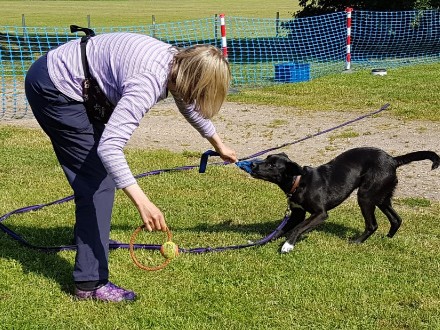
There are 3 essential ingredients to play – the dog, the toy … and you. It is all three of these components that make the play really fun, and make up what I like to call “The Triangle of Play”. Leave a toy static in a toy box: your dog may pick it up once in a while, but will soon lose interest. Yet if you pick up the toy and generate some energy with it, you’ll also pick up your dog’s interest, and there you have the “Triangle of Play”: dog, toy and handler.
Play has been a theme in class recently, and spurred on by my colleague Samantha Dobson, I’ve got round to blogging it so that I can share it with you.
So, let’s play!
Why play?
It is really important to play with your dog. Play helps strengthen your bond with your dog:
“Most types of play appear to improve social cohesion between humans and dogs, increasing their familiarity and reducing agonistic interactions” (Somerville et al, 2017 [3])
The more you engage in the right kind of play, the better the bond with your dog can get:
“Play frequency and form may therefore be an indicator of the quality of dog-owner relationships.” (Bradshaw et al, 2014 [4])
Creating a good toy drive also gives you another reward option – sometimes food just doesn’t cut it.
But I don’t know how to play!
If you’re like me, you might find “playing” difficult at first. I love structured activities – when I play with my 8-year old son, we often do arts & crafts, board games, Lego, etc. However, when it comes to imaginative play, role play, then I begin to flounder after a few minutes. Somewhere on the journey to adulthood inhibitions have crept in, and play can become stilted and awkward unless I “let go” and properly engage with him. It takes a conscious effort for me to do it; hopefully I’ll get there before he grows up all too quickly!
Not knowing how to play with their dog affects many of my students in class; they worry they’re “not doing it right”. I love teaching my two dogs Mabel and Murphy tricks, agility, obedience and so on. It’s fun for me – structured, enjoyable fun. But that is not playing.
When I watch Mabel & Murphy play together, I imagine that I’d be hard pressed to match the fun factor they generate. They take turns to chase, dart around, duck and dive, sometimes have a little tussle, sometimes play tug-of-war with gusto. It all looks brilliant fun. How can I match that? The good news is that I don’t have to – that isn’t comparing like with like. Dog’s view playing with other dogs quite differently to playing with a human. With the former it has more of a competitive element;
“when the play-partner is a person, however, the important thing is the social contact that the game produces” (Bradshaw, 2011, p.204 [1]).
It is you that makes the game fun!
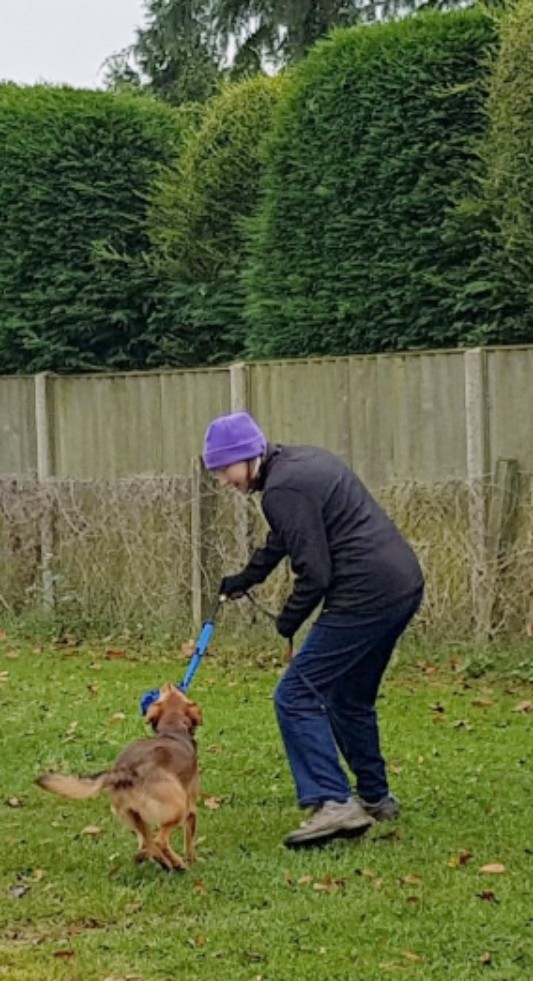
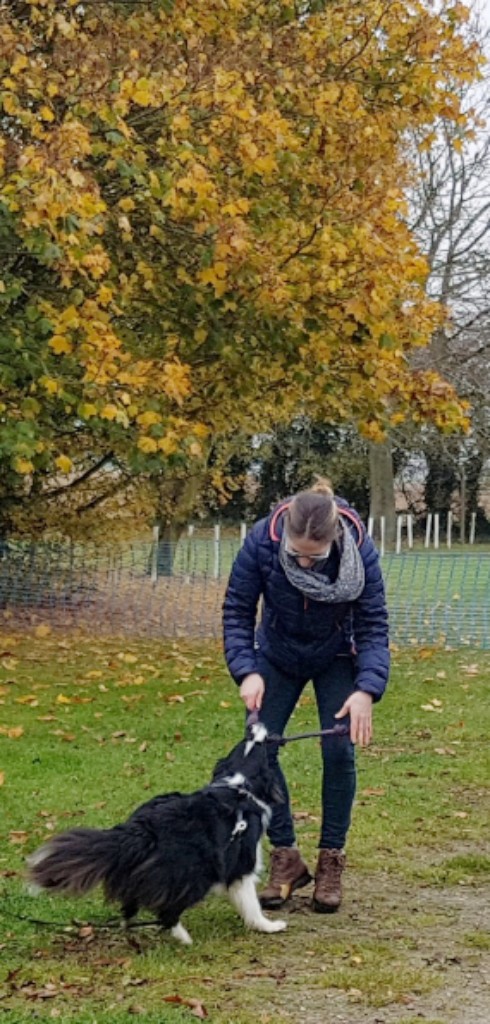
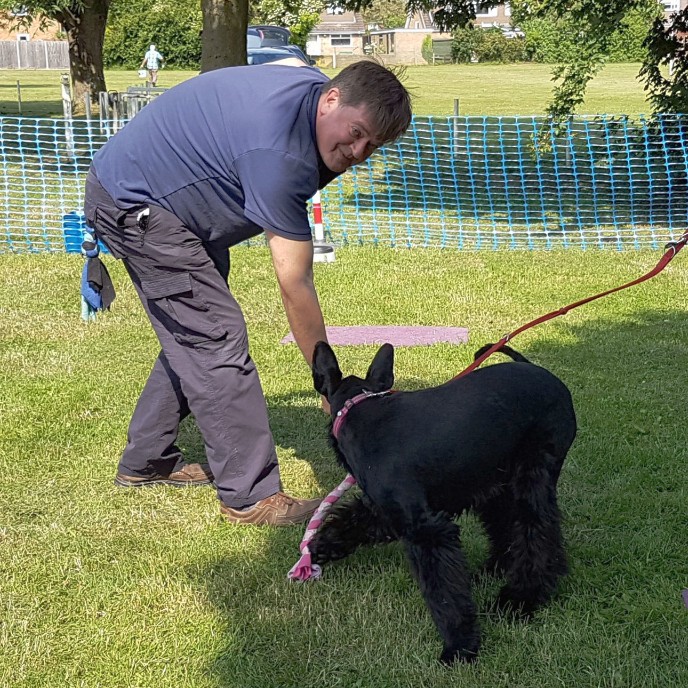
We can learn to play. In November last year, I invited Craig Ogilvie to come to my Haynes workshops to give me kick-start in Interactive Play [5] – and if you can get to one of his popular sessions then do! The triangle picture is me playing with Mabel under Craig’s guidance. My take home (or rather, take to the training class) points were to really engage with her, don’t be afraid to get puffed out, go for it, let the dog get the toy.
Note: if your dog has resource guarding / behavioural issues, consult your behaviourist for advice before embarking on play with your dog.
The Triangle of Play: Dog, Toy, Handler
1. The Dog
How will your dog like playing? Think a little about your dog’s breed – what are they designed to do? A toy breed may have very different ideas about what constitutes a good game compared to a terrier, or a gun dog, or a working dog.
Hundreds of years of breeding will have a big influence on which bits of the predatory motor patterns
ORIENT > EYE-STALK > CHASE > GRAB-BITE > KILL-BITE > DISSECT > CONSUME
(Copppinger and Coppinger, 2004, p.209)
they exhibit. It is well known that Border Collie’s are bred to have “the eye”; they exhibit ORIENT > EYE-STALK > CHASE very strongly to ensure that they work their flocks successfully. To generalise, Border Collie’s should prefer games that involve movement and chasing – so a toy attached to a flirt pole and you working the chase might be a good option for them. Terriers are bred to hunt out and kill vermin so exhibit CHASE > GRAB-BITE > KILL-BITE > HEAD-SHAKE > DISSECT motor patterns – so they should enjoy getting a good grab of a small furry toy, and having a really good rag on it (but don’t expect the toy to last long!). Ideally, retrieval gun dogs should prefer to retrieve their quarry, but it’d be a poor show at a shoot if they dissected the game: their motor patterns would typically be: ORIENT > CHASE > GRAB-BITE (Coppinger and Coppinger, 2004, p.210). So they might prefer not to engage in a full on head shake with their tug game; holding the toy may suffice.
This gives you some idea about how they will go about playing, but do bear in mind that every dog is an individual: see breed as a guide rather than a universal law.
2. The Toy
What toy will your dog like playing with? That’s really up to your dog!
Think about the texture of the toy – what do they prefer to hold in their mouth – canvas, fur, rope, smooth rubber, textured rubber, felt (e.g., tennis ball covering)? Think about the size of your dog – their toy has to comfortably fit in their mouth, can they get a good grip on it without it being a choke hazard? Does a squeaky toy excite them? As the play needs to involve you, it is helpful that you choose something you can easily get hold of (or attach to a flirt pole). If your dog is a little “mouthy” make sure there’s enough length in the toy to ensure no accidental mouth to hand contact.
The ideal toy could be a tennis ball stuffed in a knotted sock if your dog is a little bit ball (or sock) obsessed. If a ball on a rope is their thing, pick a rope width and ball size that’s appropriate to their mouth size. Maybe a long plaited fleece would suit a dog that prefers a soft feel to its “prey” but also prefers a little distance from his handler (or vice versa!). Some dogs may love a furry squeaky toy, others may prefer a canvas one. Rubber hoops are good (pullers).
A fair few dogs I know love collecting plastic bottles – they like the crinkly noise they make when they are crunched – so “upcycle” a bottle, pop it in an old footie sock. Remember, it’s what floats your dog’s boat, so think about what they naturally make a beeline for. See reference [7] for ideas from tug-e-nuff. Trial and error will play a part until you hit the jackpot. Once you do, keep that toy aside – it is the special toy for your “Triangle of Play”, so only get it out for your play sessions.
3. The Handler: YOU
Playing with your dog and their toy:
- Make the toy really exciting by wiggling it around, lots of movement; your energy and vocalisations should really get the dog going. Don’t waft it in front of your dog’s face; instead whizz it around at ground level to encourage your dog to EYE-STALK > CHASE the toy. Lose your inhibitions, don’t be shy! As long as your dog is excited to watch and chase the toy, that could be enough play for your first session. Keep it brief and lively, no more than a couple of minutes to begin with, and then pop the toy away – leave the dog wanting more!
- If your dog grabs and bites the toy, praise them with a “Good Hold”. It doesn’t matter if they don’t get a hold of it in your first few sessions, they will soon get the idea and engage with the you and the toy as their confidence grows – they might just look at it and follow it with their eyes the first few times, then next time begin to chase and sniff it, in later sessions perhaps chase and grab then release, before finally chasing, grabbing and holding. Take your time over several short cheerful sessions to develop the hold. Once they do take a hold of the you, encourage them to keep hold of it. Move with the dog, with cheerful vocalisations and plenty of praise.
- When your dog has hold of the toy, tug at it with them – a swishing side to side motion is ideal. Avoid raising the toy upwards with the dog attached to it – we’re not interested in developing a strong jaw, we’re looking at light hearted jolly play. Your dog may offer some vocalisations – go with it, they’re having fun!
- Once they’ve got the hang of holding the toy, teach them to release the toy. You’ll need another toy. Make toy no.1 really exciting by wiggling it around, lots of movement; your energy and vocalisations should really get the dog going. Once the dog has seized the toy, say “Good Hold”, and encourage some tugging. When you are ready, toy no.1 becomes ‘dead’ – you stop moving it and disengage from play (but do not release the toy). But all of a sudden you whip out toy no.2, and now it’s all about toy no.2. Really go for it! If you’re a bit puffed out and feel like a wally, you’re probably doing it right! Once your dog is reliably releasing the toy in exchange for another one, you can introduce your “Out” cue word. Click here for a nice video example from Steve Mann of the IMDT [6].
- To avoid frustration, let them win the toy – it is rewarding and will make them want to play more: “The majority of dogs do not seem to regard competitive games played with a human partner as “dominance” contests: rather, winning possession of objects during games appears to be simply rewarding. “ (Bradshaw et al, 2014 [4])
- The extent of the hold/tug really depends on your dog. Some dogs will hold on for dear life, whereas others will just have a little nibble and tug. The engagement is what matters, not the tug.
So long as it is right for your dog, you’re doing it right!
So, go and play with your dog – use the “Triangle of Play” to build your bond with your dog.
All images and text Copyright: Denise Price, 18 June 2018.
https://www.facebook.com/DenisePriceDogInstructor/
References
- John Bradshaw, In Defence of Dogs (2011), London, Penguin Books.
- Raymond Coppinger and Lorna Coppinger, Dogs (2004), London, Crosskeys Select Books.
- Sommerville, R., O’Connor, E.A., Asher, L., Applied Animal Behaviour Science (2017), Why do dogs play? Function and welfare implications of play in the domestic dog, https://doi.org/10.1016/j.applanim.2017.09.007
- Bradshaw, J. W. S., Carter, A., Rooney, N. J., Behavioural Processes 110 (2014), Why do adult dogs ‘play’? https://doi.org/10.1016/j.beproc.2014.09.023
- Craig Ogilvie: http://craigogilviedogtraining.com
- A lovely video explanation of the “Out” can be found by Steve Mann of the IMDT here: https://www.youtube.com/watch?v=d5ldRn9iS5Y
- Ideas for toys: lovely variety can be found here https://tug-e-nuff.co.uk/collections/bungee-tug-toys-1






![<div data-test='contact-form'
id='contact-form-35'
class='jetpack-contact-form-container '
data-wp-interactive='jetpack/form' data-wp-context='{"formId":"35","formHash":"24ea3e12d927098fc160932c80a47a8bcd0e3d55","showErrors":false,"errors":[],"fields":[],"isMultiStep":false,"useAjax":false,"submissionData":null,"formattedSubmissionData":[],"submissionSuccess":false,"submissionError":null,"elementId":"jp-form-24ea3e12d927098fc160932c80a47a8bcd0e3d55","isSingleInputForm":false,"isForcedHorizontal":false}'
data-wp-watch--scroll-to-wrapper="callbacks.scrollToWrapper"
>
<div class="contact-form-submission contact-form-ajax-submission" data-wp-bind--aria-hidden="state.isSuccessMessageAriaHidden" data-wp-class--submission-success="context.submissionSuccess" id="contact-form-success-24ea3e12d927098fc160932c80a47a8bcd0e3d55" tabindex="-1" aria-labelledby="contact-form-success-header-24ea3e12d927098fc160932c80a47a8bcd0e3d55"><p class="go-back-message"><a class="link" role="button" tabindex="0" data-wp-on--click="actions.goBack" href="/tag/puppy-problems/">← Back</a></p><h4 data-wp-bind--aria-hidden="state.isSuccessMessageAriaHidden" id="contact-form-success-header-24ea3e12d927098fc160932c80a47a8bcd0e3d55">Thank you for your response. ✨</h4>
<template data-wp-each--submission="context.formattedSubmissionData">
<div class="jetpack_forms_contact-form-success-summary">
<div class="field-name-wrapper">
<div class="field-type-icon" data-wp-watch="callbacks.watchFieldTypeIcon"></div>
<div class="field-name" data-wp-text="context.submission.label" data-wp-bind--hidden="!context.submission.label"></div>
</div>
<div class="field-value" data-wp-text="context.submission.value" data-wp-bind--hidden="!context.submission.showPlainValue"></div>
<a class="field-url" data-wp-bind--href="context.submission.url" data-wp-text="context.submission.value" data-wp-bind--hidden="!context.submission.url" target="_blank" rel="noopener noreferrer"></a>
<div class="field-rating" data-wp-bind--hidden="!context.submission.rating" data-wp-watch="callbacks.watchRatingIcons"></div>
<div class="field-images" data-wp-bind--hidden="!context.submission.images">
<template data-wp-each--image="context.submission.images">
<div class="field-image-option" data-wp-class--is-empty="!context.image.src">
<figure class="field-image-option__image" data-wp-class--is-empty="!context.image.src">
<img data-wp-bind--src="context.image.src" data-wp-bind--hidden="!context.image.src" />
<img src="data:image/gif;base64,R0lGODlhAQABAAD/ACwAAAAAAQABAAACADs=" data-wp-bind--hidden="context.image.src" />
</figure>
<div class="field-image-option__label-wrapper">
<span class="field-image-option__label-code" data-wp-text="context.image.letterCode"></span>
<span class="field-image-option__label" data-wp-text="context.image.label" data-wp-bind--hidden="!context.image.label"></span>
</div>
</div>
</template>
</div>
<div class="field-files" data-wp-bind--hidden="!context.submission.files">
<template data-wp-each--file="context.submission.files">
<div class="field-file">
<div class="field-file__thumbnail" data-wp-style--background-image="context.file.previewUrl" data-wp-style--mask-image="context.file.iconUrl" data-wp-bind--hidden="!context.file.hasPreview"></div>
<svg class="field-file__icon" data-wp-bind--hidden="context.file.hasPreview" width="20" height="20" viewBox="0 0 24 24" fill="none" xmlns="http://www.w3.org/2000/svg" aria-hidden="true">
<path d="M14 2H6C4.9 2 4 2.9 4 4V20C4 21.1 4.89 22 5.99 22H18C19.1 22 20 21.1 20 20V8L14 2ZM18 20H6V4H13V9H18V20Z" fill="currentColor"/>
</svg>
<span class="field-file__name" data-wp-text="context.file.name"></span>
<span class="field-file__size" data-wp-text="context.file.size"></span>
</div>
</template>
</div>
</div>
</template></div><form action='https://ukscentsport.org/2019/07/07/dogs-need-to-play/'
id='jp-form-24ea3e12d927098fc160932c80a47a8bcd0e3d55'
method='post'
class='contact-form commentsblock jetpack-contact-form__form has-no-jetpack-form-layout' aria-label="DOGS NEED TO PLAY - by Susanne Broughton"
data-wp-on--submit="actions.onFormSubmit"
data-wp-on--reset="actions.onFormReset"
data-wp-class--submission-success="context.submissionSuccess"
data-wp-class--is-first-step="state.isFirstStep"
data-wp-class--is-last-step="state.isLastStep"
data-wp-class--is-ajax-form="context.useAjax"
novalidate >
<input type='hidden' name='jetpack_contact_form_jwt' value='eyJ0eXAiOiJKV1QiLCJhbGciOiJIUzI1NiJ9.eyJlbmNyeXB0ZWRfYXR0cmlidXRlcyI6InR2OVJCWWtCUTVYMzYvVmtXTXAwdDRmNlZLYWt2Y0hCQUhmcXFGVE1qcDNhK1IwN2FEUnR0aFZLbFd4Q29aZlhPQm5hbEVCckkvelhTUDZpekgyQ2ROMVBGMXVaWEljcWhoN2FpQTFsZlZoVFpVUHV4akVvQ2RFZCtGRUpCdHUydGRjVXMvZStzZ0l2Mi9NZGVPamZJcHovZGE0aHRQNlg2N3FmWTVSdW5iMm95T0VkRGt4Q3Q4M1NGQUhXUVRDbFEvcGpXV1I0c2ZkVmxjY2FLTEFXWHJkZ3NsL1lUa093d1RmQ2dsemxUcTBVVUNaL2pxaFhHaFdMbmU4REV6b2ZTQXNoUXZDaXVWRFBSd1VTNFBCVXZkcVB4MjdsYWtuWWdSVUFFVm8zbnV3WXQreGwxU0todXlweEdqWUlUYzUwL3ZaR241RzRCSjhuNVprL3IreWcxU21jemp0S2Jrdno3M3VOYi9ZWVlLcXZqV1J2VlExRGdMN0laV1FXV0ZhN3MwVVh1NXZOUHAwR3JXRmVrS3pEUWFvQStmYnNMM0llazlUdnE1OTRvUXhjd2VXSXZ0KzVCTzZvVCthejM5SWNXTmxMQVM5S08xSGN2a1MwelJza2JsQlJDemJxOWhVOC81UDBpN0YyK2krRHAxUGp0Z0U5VGlqdEE5c3kwQUJKYTJDZmFWME4vRDBFQUFWUEJaMUtYNW1hUzV1WVdqSlIreDFVVzdleEMvbkZBZ2h2azNwNVRpVnBwWFRodEFlYU5xamFTMGJJaVVRUWt6QVJvYW4xdlBvdWJmbVRzMnhMWmZHa0JaZ3loU2VIaks1RkRkMER5TVVwUnJwT3ZKQ2ZJaTAyakczdG0wS3hWeGoxTDcwVEQ5RkpuRld6L3E4VmhCcFJwQkdyVitMem1TQVFpK0VIdjRSZXFiU1F1THZma2JmVmFmcUVGTml4OFdlUU10VnpQMmJhTjVvdnVIcVp5KzZLMVcxc0lKK1EzeG1sNXp4ZmllalA2MWpoNnVVQUtieG0zS2d5MzdrZXdZNkd3TzVkNjU2ZkRrM1lIOXMrMUNSUms4SUxSR3B0bUtFdlJFZGFIakw3alMyNTFtZ094aDhUUk8yUTBydEpoeVRBcDFEbDBhZVVTdkFSTVFyZmJkQlRDM2tvZUlpRmxEYUZqRUlocExYWGp4ZkpOWm4vTk1mTmhvNVBvOVk3ZGl2V2hLbklJOS9ZM0VHTXI2YWRTQjdqNUdEQTMzcUJodkdFTkI3OUxPYz0iLCJjb250ZW50IjoiW2NvbnRhY3QtZmllbGQgbGFiZWw9JnF1b3Q7TmFtZSZxdW90OyB0eXBlPSZxdW90O25hbWUmcXVvdDsgcmVxdWlyZWQ9JnF1b3Q7MSZxdW90Oy9dW2NvbnRhY3QtZmllbGQgbGFiZWw9JnF1b3Q7RW1haWwmcXVvdDsgdHlwZT0mcXVvdDtlbWFpbCZxdW90OyByZXF1aXJlZD0mcXVvdDsxJnF1b3Q7L11bY29udGFjdC1maWVsZCBsYWJlbD0mcXVvdDtDb21tZW50JnF1b3Q7IHR5cGU9JnF1b3Q7dGV4dGFyZWEmcXVvdDsgcmVxdWlyZWQ9JnF1b3Q7MSZxdW90Oy9dIiwiaGFzaCI6IjI0ZWEzZTEyZDkyNzA5OGZjMTYwOTMyYzgwYTQ3YThiY2QwZTNkNTUiLCJzb3VyY2UiOnsiZW50cnlfdGl0bGUiOiJET0dTIE5FRUQgVE8gUExBWSBcdTIwMTMgYnkgU3VzYW5uZVx1MDBhMEJyb3VnaHRvbiIsImVudHJ5X3BhZ2UiOjEsInNvdXJjZV9pZCI6MzUsInNvdXJjZV90eXBlIjoic2luZ2xlIiwicmVxdWVzdF91cmwiOiJodHRwczovL3Vrc2NlbnRzcG9ydC5vcmcvdGFnL3B1cHB5LXByb2JsZW1zIn0sInZlcnNpb24iOjIsImNpcGhlciI6ImFlcy0yNTYtZ2NtIn0.l00cBaRKkWHa7RfbNgsbWHElFzA7ZvNn2lsGcK_LkIw' />
<div style="" data-wp-interactive="jetpack/form" data-wp-context='{"fieldId":"g35-name","fieldType":"\u0022name\u0022","fieldLabel":"\u0022Name\u0022","fieldValue":"","fieldPlaceholder":"","fieldIsRequired":"","fieldErrorMessage":"","fieldExtra":[],"formHash":"24ea3e12d927098fc160932c80a47a8bcd0e3d55"}' class='grunion-field-"name"-wrap grunion-field-wrap' data-wp-init='callbacks.initializeField' data-wp-on--jetpack-form-reset='callbacks.initializeField' >
<label
for='g35-name' class="grunion-field-label "name"" >"Name"</label>
<input
type='text'
name='g35-name'
id='g35-name'
value=''
data-wp-bind--aria-invalid='state.fieldAriaInvalid'
data-wp-bind--value='state.getFieldValue'
aria-describedby='g35-name-text-error-message'
data-wp-on--input='actions.onFieldChange'
data-wp-on--blur='actions.onFieldBlur'
data-wp-class--has-value='state.hasFieldValue'
class='"name" grunion-field'
/>
<div id="g35-name-text-error" class="contact-form__input-error" data-wp-class--has-errors="state.fieldHasErrors">
<span class="contact-form__warning-icon" aria-hidden="true">
<svg width="16" height="16" viewBox="0 0 16 16" fill="none" xmlns="http://www.w3.org/2000/svg">
<path d="M8.50015 11.6402H7.50015V10.6402H8.50015V11.6402Z" />
<path d="M7.50015 9.64018H8.50015V6.30684H7.50015V9.64018Z" />
<path fill-rule="evenodd" clip-rule="evenodd" d="M6.98331 3.0947C7.42933 2.30177 8.57096 2.30177 9.01698 3.09469L13.8771 11.7349C14.3145 12.5126 13.7525 13.4735 12.8602 13.4735H3.14004C2.24774 13.4735 1.68575 12.5126 2.12321 11.7349L6.98331 3.0947ZM8.14541 3.58496C8.08169 3.47168 7.9186 3.47168 7.85488 3.58496L2.99478 12.2251C2.93229 12.3362 3.01257 12.4735 3.14004 12.4735H12.8602C12.9877 12.4735 13.068 12.3362 13.0055 12.2251L8.14541 3.58496Z" />
</svg>
</span>
<span data-wp-text="state.errorMessage" id="g35-name-text-error-message"></span>
</div>
</div>
<div style="" data-wp-interactive="jetpack/form" data-wp-context='{"fieldId":"g35-email","fieldType":"\u0022email\u0022","fieldLabel":"\u0022Email\u0022","fieldValue":"","fieldPlaceholder":"","fieldIsRequired":"","fieldErrorMessage":"","fieldExtra":[],"formHash":"24ea3e12d927098fc160932c80a47a8bcd0e3d55"}' class='grunion-field-"email"-wrap grunion-field-wrap' data-wp-init='callbacks.initializeField' data-wp-on--jetpack-form-reset='callbacks.initializeField' >
<label
for='g35-email' class="grunion-field-label "email"" >"Email"</label>
<input
type='text'
name='g35-email'
id='g35-email'
value=''
data-wp-bind--aria-invalid='state.fieldAriaInvalid'
data-wp-bind--value='state.getFieldValue'
aria-describedby='g35-email-text-error-message'
data-wp-on--input='actions.onFieldChange'
data-wp-on--blur='actions.onFieldBlur'
data-wp-class--has-value='state.hasFieldValue'
class='"email" grunion-field'
/>
<div id="g35-email-text-error" class="contact-form__input-error" data-wp-class--has-errors="state.fieldHasErrors">
<span class="contact-form__warning-icon" aria-hidden="true">
<svg width="16" height="16" viewBox="0 0 16 16" fill="none" xmlns="http://www.w3.org/2000/svg">
<path d="M8.50015 11.6402H7.50015V10.6402H8.50015V11.6402Z" />
<path d="M7.50015 9.64018H8.50015V6.30684H7.50015V9.64018Z" />
<path fill-rule="evenodd" clip-rule="evenodd" d="M6.98331 3.0947C7.42933 2.30177 8.57096 2.30177 9.01698 3.09469L13.8771 11.7349C14.3145 12.5126 13.7525 13.4735 12.8602 13.4735H3.14004C2.24774 13.4735 1.68575 12.5126 2.12321 11.7349L6.98331 3.0947ZM8.14541 3.58496C8.08169 3.47168 7.9186 3.47168 7.85488 3.58496L2.99478 12.2251C2.93229 12.3362 3.01257 12.4735 3.14004 12.4735H12.8602C12.9877 12.4735 13.068 12.3362 13.0055 12.2251L8.14541 3.58496Z" />
</svg>
</span>
<span data-wp-text="state.errorMessage" id="g35-email-text-error-message"></span>
</div>
</div>
<div style="" data-wp-interactive="jetpack/form" data-wp-context='{"fieldId":"g35-comment","fieldType":"\u0022textarea\u0022","fieldLabel":"\u0022Comment\u0022","fieldValue":"","fieldPlaceholder":"","fieldIsRequired":"","fieldErrorMessage":"","fieldExtra":[],"formHash":"24ea3e12d927098fc160932c80a47a8bcd0e3d55"}' class='grunion-field-"textarea"-wrap grunion-field-wrap' data-wp-init='callbacks.initializeField' data-wp-on--jetpack-form-reset='callbacks.initializeField' >
<label
for='g35-comment' class="grunion-field-label "textarea"" >"Comment"</label>
<input
type='text'
name='g35-comment'
id='g35-comment'
value=''
data-wp-bind--aria-invalid='state.fieldAriaInvalid'
data-wp-bind--value='state.getFieldValue'
aria-describedby='g35-comment-text-error-message'
data-wp-on--input='actions.onFieldChange'
data-wp-on--blur='actions.onFieldBlur'
data-wp-class--has-value='state.hasFieldValue'
class='"textarea" grunion-field'
/>
<div id="g35-comment-text-error" class="contact-form__input-error" data-wp-class--has-errors="state.fieldHasErrors">
<span class="contact-form__warning-icon" aria-hidden="true">
<svg width="16" height="16" viewBox="0 0 16 16" fill="none" xmlns="http://www.w3.org/2000/svg">
<path d="M8.50015 11.6402H7.50015V10.6402H8.50015V11.6402Z" />
<path d="M7.50015 9.64018H8.50015V6.30684H7.50015V9.64018Z" />
<path fill-rule="evenodd" clip-rule="evenodd" d="M6.98331 3.0947C7.42933 2.30177 8.57096 2.30177 9.01698 3.09469L13.8771 11.7349C14.3145 12.5126 13.7525 13.4735 12.8602 13.4735H3.14004C2.24774 13.4735 1.68575 12.5126 2.12321 11.7349L6.98331 3.0947ZM8.14541 3.58496C8.08169 3.47168 7.9186 3.47168 7.85488 3.58496L2.99478 12.2251C2.93229 12.3362 3.01257 12.4735 3.14004 12.4735H12.8602C12.9877 12.4735 13.068 12.3362 13.0055 12.2251L8.14541 3.58496Z" />
</svg>
</span>
<span data-wp-text="state.errorMessage" id="g35-comment-text-error-message"></span>
</div>
</div>
<p class='contact-submit'>
<div class="contact-form__error" data-wp-class--show-errors="state.showFormErrors"><span class="contact-form__warning-icon" aria-hidden="true"><i></i></span><span class="contact-form__error-message" tabindex="-1" data-wp-watch="callbacks.focusOnValidationError" data-wp-text="state.getFormErrorMessage"></span><ul aria-label="Form errors">
<template data-wp-each="state.getErrorList" data-wp-key="context.item.id">
<li><a data-wp-bind--href="context.item.anchor" data-wp-on--click="actions.scrollIntoView" data-wp-text="context.item.label"></a></li>
</template>
</ul></div><div class="contact-form__error" data-wp-class--show-errors="state.showSubmissionError" data-wp-text="context.submissionError" tabindex="-1" data-wp-watch="callbacks.focusOnSubmissionError"></div> <button type='submit' class='pushbutton-wide'>Submit</button> <input type='hidden' name='contact-form-id' value='35' />
<input type='hidden' name='action' value='grunion-contact-form' />
<input type='hidden' name='contact-form-hash' value='24ea3e12d927098fc160932c80a47a8bcd0e3d55' />
</p>
<p style="display: none !important;" class="akismet-fields-container" data-prefix="ak_"><label>Δ<textarea name="ak_hp_textarea" cols="45" rows="8" maxlength="100"></textarea></label><input type="hidden" id="ak_js_1" name="ak_js" value="70"/><script type="text/javascript">
/* <![CDATA[ */
document.getElementById( "ak_js_1" ).setAttribute( "value", ( new Date() ).getTime() );
/* ]]> */
</script>
</p></form>
</div>](https://ukscentsport.org/wp-content/uploads/2019/06/pexels-photo-1364729-1.jpeg)
 UK SCENT SPORT