What is punishment?

Julia Langlands

Do you use punishment when teaching and living with your dog?

Many people say that they don’t use punishment, but are they correct? What is punishment anyway?

Punishment: An operant conditioning term that refers to the application or removal of something immediately following a behaviour in order to reduce the likelihood of the behaviour being repeated again in the future.

The word ‘punishment’ has such a stigma attached to it with regards dog psychology/training – it seems to be only associated with abuse and bad practise in the public eye. This is understandable as we tend to think of punishment in human terms, as retribution, paying for misdeeds or ‘getting our own back’. We think of parking fines and imprisonment, loss of freedom etc. So in this context it would be an unpleasant and largely ineffective training approach if applied to dogs!

In the scientific context however the term ‘punishment’ is completely misunderstood. It refers to the act of providing a consequence in relation to a behaviour in order to decrease the likelihood of that behaviour being repeated, the ‘punishment’ is delivered in a neutral state and no emotion is implied or involved. This should be descriptive and usually ‘blocks’ an unwanted behaviour before it starts to escalate, thus allowing for an alternative behaviour to be trained in it’s place so that we can reward this, and teach a better response or reaction in future. So, looking at it this way, this is not cruel or abusive at all, it is a very basic fundamental need, it ensures clarity and confidence in behaviours, allows us to halt a ritual that is damaging so that we can redirect onto a great alternative that is rewarding. This maximises the potential for enjoyment of joint activities and ensures that the dog has all of the information that he needs to live in our complex world and to thrive, be included in family life and enjoy freedom within the structure. Dogs with boundaries are relaxed and confident, they know the rules, stress levels are low and security is high!

Some scenarios;

A dog leaving his food in order to go for a drink from the water bowl and returning to find that the cat has finished his dinner – the act of abandoning his meal has been punished. He may begin to guard his food from the cat – so not a good outcome here. Or he may merely learn to be more watchful when the cat is around – maybe doling out a bit of punishment himself in the form of strong eye contact. We could avoid this entirely by not allowing the cat to approach the food bowl.

Saying ‘No’ with a firm glance when our dog goes to steal our lunch is a punishment. In future he will understand that our food is off limits – possibly a life saver if that food happens to be a bowl of unattended chocolate raisins!

Telling off a dog that has chewed up the sofa earlier that day is punishing. Not a good time to punish however – the chewing was probably stress related due to our absence, likely due to our poor planning or a lack of fulfilment in the dog, and probably occurred hours ago! This is not an appropriate time or context to use punishment at all. Punish yourself by hitting the credit card to buy another sofa but don’t punish the dog, it’s too late, it’s not appropriate and it could make matters worse!

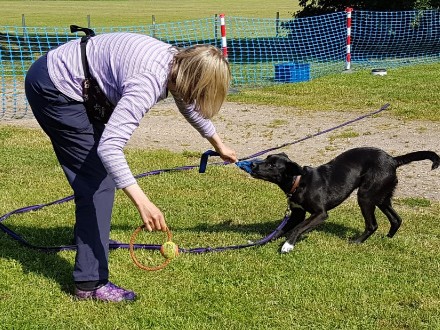
Putting a tennis ball into a pocket when our dog bites at our hand in excitement for a game is a punishment, this provides not only a punishing consequence for the teeth to maintain safety, but very importantly, provides a consequence for excessive excitement (this part is passive association so isn’t technically punishment, but it is an association that is super-important!!). Excitement slips into anxiety very easily and isn’t a good state to promote, we CERTAINLY shouldn’t throw the ball at this point.

Clapping your hands to interrupt with a startle as a dog dips her head into the bin to retrieve the string from the Sunday Roast is a punishment! Again possibly a life saving punishment, there’s tin foil and cooked chicken bones in there too!

Punishment gets a terrible reputation because of the potential for abuse, and some terrible misapplication in the past, BUT It is the way in which punishment is applied, and the circumstances surrounding the punishment that makes it a kindness or a cruelty, not the act itself.

A punishment that is too extreme, inappropriate in context or administered in anger or frustration is not in the spirit of natural punishment, and would be better termed abuse! In nature dogs gain such a lot of information from the environment through punishments and rewards – equally. They learn what is safe and healthy and what is not, how to approach dogs if they want to play and what kind of approach results in social aggression, they learn what gets them what they want and they learn the boundaries of others – in our complicated and busy human world we need to be sure to describe the many rules to live by very clearly indeed. If we tell our dogs what to do and reward then this is a great start! We mustn’t omit the other side of the coin however, rules that are enforced maintain physical safety, and promote emotional calmness. This is a need and a right, this is our job as caretaker, owner and as the dog’s family.

It is very unfortunate that behavioural research adopted the term ‘punishment’ in this way. The negative cultural connotations associated with it in no way describe the scientific principle related to decreasing a given behaviour. Historically punishment has been misapplied and this has created a huge taboo when discussing the concept frankly and openly. But I think we need to be clear about what it is we are referring to when we discuss any terms used in behaviour modification, as some such as this could be misconstrued. In fact they regularly are – and this is currently leading to a sinister upsurge of unbalanced, unhappy, stressed and miserable dogs. It is no freak coincidence that euthanasia within rescue, and dog bites have increased massively since society adopted the ‘punishment is nasty and unnecessary’ stance. I think that many people have thrown the baby, the bath and their common sense out with the bath water! In the true sense punishment is calming and descriptive, necessary and kind.

So to sum up, unless we allow our dogs to do only what they want to do when they want to do it, and hang the consequences, safety and emotional balance, then perhaps a more accurate statement would be to say that we ‘do not use abusive methods’. Or perhaps we could state that we ‘avoid all but low level correction’, ‘preferring to use reward based training where possible’. This would be more accurate and would be a great basis for training and behaviour! Genuine ‘reward only’ approach is not kind at all when it comes to behaviour intervention for the most part! It is a bastardisation of the science, it is ineffective for many dogs and for addressing many issues, and for me can be as confusing and cruel as adopting an approach that is devoid of all reward.

Food for thought… both punishment AND reward can be a kindness or a cruelty. One without the other will never be enough to help every dog in every scenario.

if you enjoyed this read please take a look at julia’s page,

https://www.facebook.com/balancebehaviour/

Mantrailing is more than training.

Please read this article from Mantrailing uk

Find an event at Doghampton

Mantrailing is like no other activity or sport that you can take part in with your pet dog. It is completely unique dog training in many ways but quite interestingly, it can help solve a number of unwanted behavioural problems that may challenge your every day life with your dog such as fear, hyperactivity, phobias, stress, anxiety, reactivity and aggression.

Mantrailing is allowing the dog to make the right choices independently and will be much more satisfying and prioritising the preferred habits in the brain. It has the effect that over time, it changes unwanted habitual behavior and shapes new behavior that is the final, desired goal. It interrupts and redirects unwanted dog behavior, will give the dog satisfaction and can be therapeutic. This, in turn, will provide various benefits and will give you and the dog more confidence and stress free experiences.

These dog behaviours can lead to you becoming extremely isolated with your dog and having stressful and disappointing experiences and missing out on taking part in various activities or even simple dog walks.

Mantrailing is the ultimate sport for turning a pessimist into an optimist!

It is one of the very few sports where the dog can work freely and the handler can enjoy watching their dog work. It is all about putting the dog in control and the handlers taking a back seat and watching how the dog works tricky trails out themselves. Through this, the handler learns to read the dogs body language, which creates a great bond and ultimately will equate to further progression in their behavioural and every-day training.

By taking part in Mantrailing, both you and your dog become a team – the best team imaginable! You will achieve success after success together, getting a buzz each time a missing person is found.

This will also help with building the dog’s confidence and self-esteem up in a very short period of time. It helps the dog to become less stressed, relax, learn a new game and have endless fun along the way. By working as a team, the dog will naturally want to engage with their handler and learn.

A dog’s nose dominates its brain, so naturally Mantrailing provides mental, intellectual stimulation for your dog, providing an exceptional workout for the brain, tiring them out without the need for physical exercise. This is perfect for dogs that are still bouncing around the house after endless walks, puppies, elderly dogs or dogs that are unable to complete as much physical exercise for one reason or another.

“It is invaluable dog training.”

It´s not competitive or over arousing like some other dog sports. It is fantastic at getting the dogs to solve problems, which in turn will build confidence and make the dog more likely to respond to behavioural modification training as the dog will want to engage and learn. This will help to change the dog’s reaction to certain situations such as a person, a dog, another animal or person.

“By making Mantrailing the best game ever, we change the priorities for the dog.”

Behaviour, that has become habitual for the dog, such as chasing a runner or barking at another dog, can be challenging to reverse. By making Mantrailing, which is a natural game, more fun, exciting and rewarding, we are changing the priorities for the dog. All over sudden, chasing that bike isn´t as important as following the trail that leads to receiving the best reward. A lot of dogs find trailing rewarding in itself.

Once the dog understands the concept of Mantrailing, which happens usually within the first session, there is no stopping them from doing their ‘job’. The dogs are extremely intent on following the trail to find their missing person, that whatever or whoever gets in their way is completely ignored. This has, for expample, enabled dog reactive dogs to ignore any other dogs on or near their trail.

Nervous dogs have been brave enough to pass objects or scenarios they once wouldn’t pass or take food from strangers that they might not normally approach.

Olfaction is believed to be the dogs’ most powerful and perhaps important sense. Their sensory world is impressively different from ours, they observe their world through relentless sniffing and scent discrimination. Dogs can have up to 300 million olfactory cells, whereas us humans have only about 15 million.

“It is believed that they can detect a tea spoon of sugar in an olympic sized pool.”

Canine olfaction is a growing area of scientific investigation and there are many new applications surfacing every year. The dogs’ brain is build around the information it gets from scent which is closely linked to emotions. Endorphins are chemicals that are produced in the brain during times of stimulation and excitement, they create feelings of calmness and happiness and decrease stress and anxiety.

When endorphin levels are too low the dog is likely to feel under a lot of stress, which can result in undesired or obsessive behaviours that the dogs use as a mechanism to cope. Anything that induces pain or excitement boosts endorphin levels, so a dog could chew his own paw, spin, or chase shadows all day as their way of creating enough endorphins for normal function.

The more the brain can be engaged and challenged with new behaviours, the more relaxed and content the dog will be. Stimulating the dog mentally and physically can help it cope with lower than average levels of endorphins being produced.

So what are you waiting for? Get trailing!

To find out more about Mantrailing and how to get involved, visit our events page or join our Facebook group “Mantrailing Association UK”

Find out more

Sign up for more info

References

https://www.researchgate.net/publication/280446218_Canine_Olfaction_Scent_Sign_and_Situation

http://www.balancebehaviour.org/

The Importance of play.

The Triangle of Play
This is written by a good friend of mine the legend that is Denise Price. Aka ‘gripper’
There is a link to her page below please take a look.

Triangle-of-Play

The Triangle of Play

There are 3 essential ingredients to play – the dog, the toy …  and you. It is all three of these components that make the play really fun, and make up what I like to call “The Triangle of Play”. Leave a toy static in a toy box: your dog may pick it up once in a while, but will soon lose interest. Yet if you pick up the toy and generate some energy with it, you’ll also pick up your dog’s interest, and there you have the “Triangle of Play”: dog, toy and handler.

Play has been a theme in class recently, and spurred on by my colleague Samantha Dobson, I’ve got round to blogging it so that I can share it with you.

So, let’s play!

Why play?

It is really important to play with your dog. Play helps strengthen your bond with your dog:

“Most types of play appear to improve social cohesion between humans and dogs, increasing their familiarity and reducing agonistic interactions” (Somerville et al, 2017 [3])

The more you engage in the right kind of play, the better the bond with your dog can get:

“Play frequency and form may therefore be an indicator of the quality of dog-owner relationships.” (Bradshaw et al, 2014 [4])

Creating a good toy drive also gives you another reward option – sometimes food just doesn’t cut it.

But I don’t know how to play!

Tug-game

If you’re like me, you might find “playing” difficult at first. I love structured activities – when I play with my 8-year old son, we often do arts & crafts, board games, Lego, etc. However, when it comes to imaginative play, role play, then I begin to flounder after a few minutes. Somewhere on the journey to adulthood inhibitions have crept in, and play can become stilted and awkward unless I “let go” and properly engage with him. It takes a conscious effort for me to do it; hopefully I’ll get there before he grows up all too quickly!

Not knowing how to play with their dog affects many of my students in class; they worry they’re “not doing it right”. I love teaching my two dogs Mabel and Murphy tricks, agility, obedience and so on. It’s fun for me – structured, enjoyable fun. But that is not playing.

When I watch Mabel & Murphy play together, I imagine that I’d be hard pressed to match the fun factor they generate. They take turns to chase, dart around, duck and dive, sometimes have a little tussle, sometimes play tug-of-war with gusto. It all looks brilliant fun. How can I match that? The good news is that I don’t have to – that isn’t comparing like with like. Dog’s view playing with other dogs quite differently to playing with a human. With the former it has more of a competitive element;

“when the play-partner is a person, however, the important thing is the social contact that the game produces” (Bradshaw, 2011, p.204 [1]).

It is you that makes the game fun!

We can learn to play. In November last year, I invited Craig Ogilvie to come to my Haynes workshops to give me kick-start in Interactive Play [5] – and if you can get to one of his popular sessions then do! The triangle picture is me playing with Mabel under Craig’s guidance. My take home (or rather, take to the training class) points were to really engage with her, don’t be afraid to get puffed out, go for it, let the dog get the toy.

Note: if your dog has resource guarding / behavioural issues, consult your behaviourist for advice before embarking on play with your dog.

The Triangle of Play: Dog, Toy, Handler

1. The Dog

Border-Collie-at-play

How will your dog like playing? Think a little about your dog’s breed – what are they designed to do? A toy breed may have very different ideas about what constitutes a good game compared to a terrier, or a gun dog, or a working dog.

Hundreds of years of breeding will have a big influence on which bits of the predatory motor patterns

ORIENT > EYE-STALK > CHASE > GRAB-BITE > KILL-BITE > DISSECT > CONSUME

(Copppinger and Coppinger, 2004, p.209)

they exhibit. It is well known that Border Collie’s are bred to have “the eye”; they exhibit ORIENT > EYE-STALK > CHASE very strongly to ensure that they work their flocks successfully. To generalise, Border Collie’s should prefer games that involve movement and chasing – so a toy attached to a flirt pole and you working the chase might be a good option for them. Terriers are bred to hunt out and kill vermin so exhibit CHASE > GRAB-BITE > KILL-BITE > HEAD-SHAKE > DISSECT motor patterns – so they should enjoy getting a good grab of a small furry toy, and having a really good rag on it (but don’t expect the toy to last long!). Ideally, retrieval gun dogs should prefer to retrieve their quarry, but it’d be a poor show at a shoot if they dissected the game: their motor patterns would typically be: ORIENT > CHASE > GRAB-BITE (Coppinger and Coppinger, 2004, p.210). So they might prefer not to engage in a full on head shake with their tug game; holding the toy may suffice.

This gives you some idea about how they will go about playing, but do bear in mind that every dog is an individual: see breed as a guide rather than a universal law.

2. The Toy

What toy will your dog like playing with? That’s really up to your dog!

Think about the texture of the toy – what do they prefer to hold in their mouth – canvas, fur, rope, smooth rubber, textured rubber, felt (e.g., tennis ball covering)? Think about the size of your dog – their toy has to comfortably fit in their mouth, can they get a good grip on it without it being a choke hazard? Does a squeaky toy excite them? As the play needs to involve you, it is helpful that you choose something you can easily get hold of (or attach to a flirt pole). If your dog is a little “mouthy” make sure there’s enough length in the toy to ensure no accidental mouth to hand contact.

Plaited-Fleece-Toy

The ideal toy could be a tennis ball stuffed in a knotted sock if your dog is a little bit ball (or sock) obsessed. If a ball on a rope is their thing, pick a rope width and ball size that’s appropriate to their mouth size. Maybe a long plaited fleece would suit a dog that prefers a soft feel to its “prey” but also prefers a little distance from his handler (or vice versa!). Some dogs may love a furry squeaky toy, others may prefer a canvas one. Rubber hoops are good (pullers).

A fair few dogs I know love collecting plastic bottles – they like the crinkly noise they make when they are crunched – so “upcycle” a bottle, pop it in an old footie sock. Remember, it’s what floats your dog’s boat, so think about what they naturally make a beeline for. See reference [7] for ideas from tug-e-nuff. Trial and error will play a part until you hit the jackpot. Once you do, keep that toy aside – it is the special toy for your “Triangle of Play”, so only get it out for your play sessions.

3. The Handler: YOU

Playing with your dog and their toy:

  • Make the toy really exciting by wiggling it around, lots of movement; your energy and vocalisations should really get the dog going. Don’t waft it in front of your dog’s face; instead whizz it around at ground level to encourage your dog to EYE-STALK > CHASE the toy. Lose your inhibitions, don’t be shy! As long as your dog is excited to watch and chase the toy, that could be enough play for your first session. Keep it brief and lively, no more than a couple of minutes to begin with, and then pop the toy away – leave the dog wanting more!

  • If your dog grabs and bites the toy, praise them with a “Good Hold”. It doesn’t matter if they don’t get a hold of it in your first few sessions, they will soon get the idea and engage with the you and the toy as their confidence grows – they might just look at it and follow it with their eyes the first few times, then next time begin to chase and sniff it, in later sessions perhaps chase and grab then release, before finally chasing, grabbing and holding. Take your time over several short cheerful sessions to develop the hold. Once they do take a hold of the you, encourage them to keep hold of it. Move with the dog, with cheerful vocalisations and plenty of praise.

  • When your dog has hold of the toy, tug at it with them – a swishing side to side motion is ideal. Avoid raising the toy upwards with the dog attached to it – we’re not interested in developing a strong jaw, we’re looking at light hearted jolly play. Your dog may offer some vocalisations – go with it, they’re having fun!

  • Once they’ve got the hang of holding the toy, teach them to release the toy. You’ll need another toy. Make toy no.1 really exciting by wiggling it around, lots of movement; your energy and vocalisations should really get the dog going. Once the dog has seized the toy, say “Good Hold”, and encourage some tugging. When you are ready, toy no.1 becomes ‘dead’ – you stop moving it and disengage from play (but do not release the toy). But all of a sudden you whip out toy no.2, and now it’s all about toy no.2. Really go for it! If you’re a bit puffed out and feel like a wally, you’re probably doing it right! Once your dog is reliably releasing the toy in exchange for another one, you can introduce your “Out” cue word. Click here for a nice video example from Steve Mann of the IMDT [6].

  • To avoid frustration, let them win the toy – it is rewarding and will make them want to play more: “The majority of dogs do not seem to regard competitive games played with a human partner as “dominance” contests: rather, winning possession of objects during games appears to be simply rewarding. “ (Bradshaw et al, 2014 [4])

  • The extent of the hold/tug really depends on your dog. Some dogs will hold on for dear life, whereas others will just have a little nibble and tug. The engagement is what matters, not the tug.

So long as it is right for your dog, you’re doing it right!

2-toy-play

So, go and play with your dog – use the “Triangle of Play” to build your bond with your dog.

All images and text Copyright: Denise Price, 18 June 2018.

https://www.facebook.com/DenisePriceDogInstructor/

References

  1. John Bradshaw, In Defence of Dogs (2011), London, Penguin Books.
  2. Raymond Coppinger and Lorna Coppinger, Dogs (2004), London, Crosskeys Select Books.
  3. Sommerville, R., O’Connor, E.A., Asher, L., Applied Animal Behaviour Science (2017), Why do dogs play? Function and welfare implications of play in the domestic dog,  https://doi.org/10.1016/j.applanim.2017.09.007
  4. Bradshaw, J. W. S., Carter, A., Rooney, N. J., Behavioural Processes 110 (2014), Why do adult dogs ‘play’? https://doi.org/10.1016/j.beproc.2014.09.023
  5. Craig Ogilvie: http://craigogilviedogtraining.com
  6. A lovely video explanation of the “Out” can be found by Steve Mann of the IMDT here: https://www.youtube.com/watch?v=d5ldRn9iS5Y
  7. Ideas for toys: lovely variety can be found here https://tug-e-nuff.co.uk/collections/bungee-tug-toys-1

7 Reasons to take up Mantrailing with your Dog- by Susanne Broughton

MANTRAILING MYTHS
You need to be very fit for this.

You need to own a working type dog.

It is not suitable for pets

I wont fit in

My dog is too nervous to take part

All the above are false, One of the best trailing dogs I have seen is a Chihuahua called Flynn, (I think I have fallen in love with him)!! Most dogs can join in, any age and breed. We can make the trails suitable to you and your dog, for the adventurous we will aim towards woodland and cross country trails. For the less adventurous shorter trails on paths, grass areas and sometimes pubs!

If you think you are you ready for a fun new dog sport, but still unsure of signing up. Why not try an introduction day? 2 to 3 hours in a fab location, It will give you the chance to see how we work and whether this is for you.

WHAT IS MANTRAILING?

‘Mantrailing’ is the search for a specific person know as a runner (dont worry you dont have to run) by you and your dog. The dog is given the scent of the runner from a piece of their clothing (normally gloves or scarf) this if where we rely on the dogs amazing sense of smell and their instinctive behaviour to follow the direction the ‘runner’ went and eventually find them.

My dog cant do that Ill look like a fool

All dogs can. Some just take longer to learn the basics.

DO I NEED LOADS OF EXPENSIVE EQUIPMENT?

We supply all that you require for the introduction session.  As you move on through the levels, we can advise on dog equipment which is generally just a suitable harness and long lead (5 meters).

What personal equipment do I need?

Outdoor clothing, good outdoor footwear and possibly waterproofs for our lovely British weather!

Why trail with your dog?

1.Strengthens the bond and trust between you and your dog by working together to solve the problem.

2. Can help nervous dogs become more confident

3.Builds self-assurance, self-motivation, independence because they have to think for themselves.

4. Reduces stress and anxiety by the release of happy hormones.

5. Even if your dog has no recall it can still take part.

6. All breeds can join in

7 Teaches you to read your dogs body language

We work after the Kocher Method and only ever use positive reinforcement,
Rewarding teamwork and a knowledgeable Instructor is waiting to take you on your incredible journey.

Please check out our facebook page for upcoming events

http://www.facebook.com/doghampton