

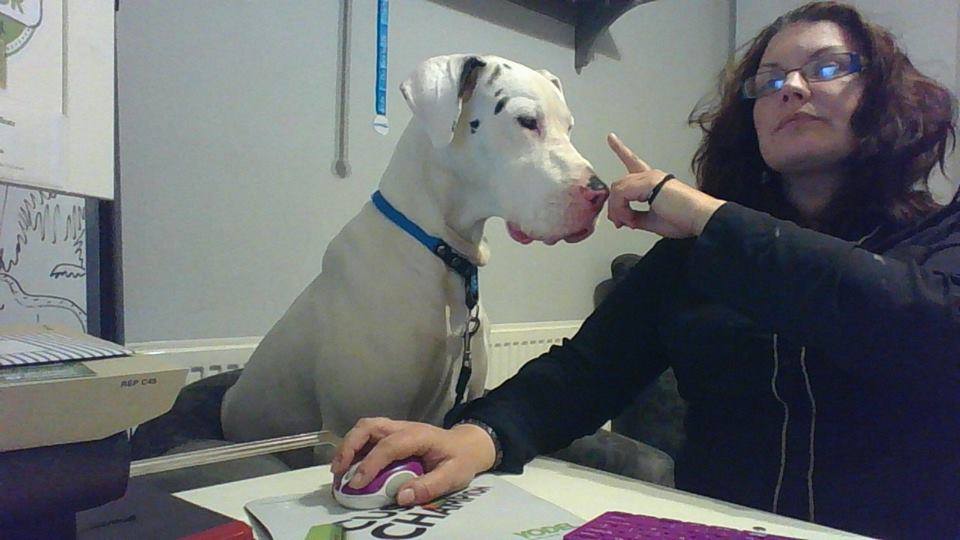
Do you use punishment when teaching and living with your dog?
Many people say that they don’t use punishment, but are they correct? What is punishment anyway?
Punishment: An operant conditioning term that refers to the application or removal of something immediately following a behaviour in order to reduce the likelihood of the behaviour being repeated again in the future.
The word ‘punishment’ has such a stigma attached to it with regards dog psychology/training – it seems to be only associated with abuse and bad practise in the public eye. This is understandable as we tend to think of punishment in human terms, as retribution, paying for misdeeds or ‘getting our own back’. We think of parking fines and imprisonment, loss of freedom etc. So in this context it would be an unpleasant and largely ineffective training approach if applied to dogs!
In the scientific context however the term ‘punishment’ is completely misunderstood. It refers to the act of providing a consequence in relation to a behaviour in order to decrease the likelihood of that behaviour being repeated, the ‘punishment’ is delivered in a neutral state and no emotion is implied or involved. This should be descriptive and usually ‘blocks’ an unwanted behaviour before it starts to escalate, thus allowing for an alternative behaviour to be trained in it’s place so that we can reward this, and teach a better response or reaction in future. So, looking at it this way, this is not cruel or abusive at all, it is a very basic fundamental need, it ensures clarity and confidence in behaviours, allows us to halt a ritual that is damaging so that we can redirect onto a great alternative that is rewarding. This maximises the potential for enjoyment of joint activities and ensures that the dog has all of the information that he needs to live in our complex world and to thrive, be included in family life and enjoy freedom within the structure. Dogs with boundaries are relaxed and confident, they know the rules, stress levels are low and security is high!
Some scenarios;
A dog leaving his food in order to go for a drink from the water bowl and returning to find that the cat has finished his dinner – the act of abandoning his meal has been punished. He may begin to guard his food from the cat – so not a good outcome here. Or he may merely learn to be more watchful when the cat is around – maybe doling out a bit of punishment himself in the form of strong eye contact. We could avoid this entirely by not allowing the cat to approach the food bowl.
Saying ‘No’ with a firm glance when our dog goes to steal our lunch is a punishment. In future he will understand that our food is off limits – possibly a life saver if that food happens to be a bowl of unattended chocolate raisins!
Telling off a dog that has chewed up the sofa earlier that day is punishing. Not a good time to punish however – the chewing was probably stress related due to our absence, likely due to our poor planning or a lack of fulfilment in the dog, and probably occurred hours ago! This is not an appropriate time or context to use punishment at all. Punish yourself by hitting the credit card to buy another sofa but don’t punish the dog, it’s too late, it’s not appropriate and it could make matters worse!
Putting a tennis ball into a pocket when our dog bites at our hand in excitement for a game is a punishment, this provides not only a punishing consequence for the teeth to maintain safety, but very importantly, provides a consequence for excessive excitement (this part is passive association so isn’t technically punishment, but it is an association that is super-important!!). Excitement slips into anxiety very easily and isn’t a good state to promote, we CERTAINLY shouldn’t throw the ball at this point.
Clapping your hands to interrupt with a startle as a dog dips her head into the bin to retrieve the string from the Sunday Roast is a punishment! Again possibly a life saving punishment, there’s tin foil and cooked chicken bones in there too!
Punishment gets a terrible reputation because of the potential for abuse, and some terrible misapplication in the past, BUT It is the way in which punishment is applied, and the circumstances surrounding the punishment that makes it a kindness or a cruelty, not the act itself.
A punishment that is too extreme, inappropriate in context or administered in anger or frustration is not in the spirit of natural punishment, and would be better termed abuse! In nature dogs gain such a lot of information from the environment through punishments and rewards – equally. They learn what is safe and healthy and what is not, how to approach dogs if they want to play and what kind of approach results in social aggression, they learn what gets them what they want and they learn the boundaries of others – in our complicated and busy human world we need to be sure to describe the many rules to live by very clearly indeed. If we tell our dogs what to do and reward then this is a great start! We mustn’t omit the other side of the coin however, rules that are enforced maintain physical safety, and promote emotional calmness. This is a need and a right, this is our job as caretaker, owner and as the dog’s family.
It is very unfortunate that behavioural research adopted the term ‘punishment’ in this way. The negative cultural connotations associated with it in no way describe the scientific principle related to decreasing a given behaviour. Historically punishment has been misapplied and this has created a huge taboo when discussing the concept frankly and openly. But I think we need to be clear about what it is we are referring to when we discuss any terms used in behaviour modification, as some such as this could be misconstrued. In fact they regularly are – and this is currently leading to a sinister upsurge of unbalanced, unhappy, stressed and miserable dogs. It is no freak coincidence that euthanasia within rescue, and dog bites have increased massively since society adopted the ‘punishment is nasty and unnecessary’ stance. I think that many people have thrown the baby, the bath and their common sense out with the bath water! In the true sense punishment is calming and descriptive, necessary and kind.
So to sum up, unless we allow our dogs to do only what they want to do when they want to do it, and hang the consequences, safety and emotional balance, then perhaps a more accurate statement would be to say that we ‘do not use abusive methods’. Or perhaps we could state that we ‘avoid all but low level correction’, ‘preferring to use reward based training where possible’. This would be more accurate and would be a great basis for training and behaviour! Genuine ‘reward only’ approach is not kind at all when it comes to behaviour intervention for the most part! It is a bastardisation of the science, it is ineffective for many dogs and for addressing many issues, and for me can be as confusing and cruel as adopting an approach that is devoid of all reward.
Food for thought… both punishment AND reward can be a kindness or a cruelty. One without the other will never be enough to help every dog in every scenario.
if you enjoyed this read please take a look at julia’s page,
 UK SCENT SPORT