Bringing home a rescue dog is an incredibly rewarding experience, but let’s be honest sometimes it feels like you’ve just adopted a furry little question mark. One minute they’re cautiously sniffing around, and the next, they’re hiding behind the couch like it’s a zombie apocalypse. If your new pup is on the nervous side, don’t worry force-free training, tapping into the natural desires and patience can work wonders.
Meet Goose – My Own Rescue Success Story
Before we start, let me introduce you to Goose, my own rescue dog. When Goose first arrived, he was anxious and unsure of his new surroundings. With patience, positive reinforcement, and force-free training, he slowly blossomed into the confident (so of the time) and loving companion he is today. His journey inspired me to help other dogs adjust and thrive, which is a large part of the work DogHampton in Northamptonshire do, we are dedicated to force-free training and helping dogs build trust with their humans.
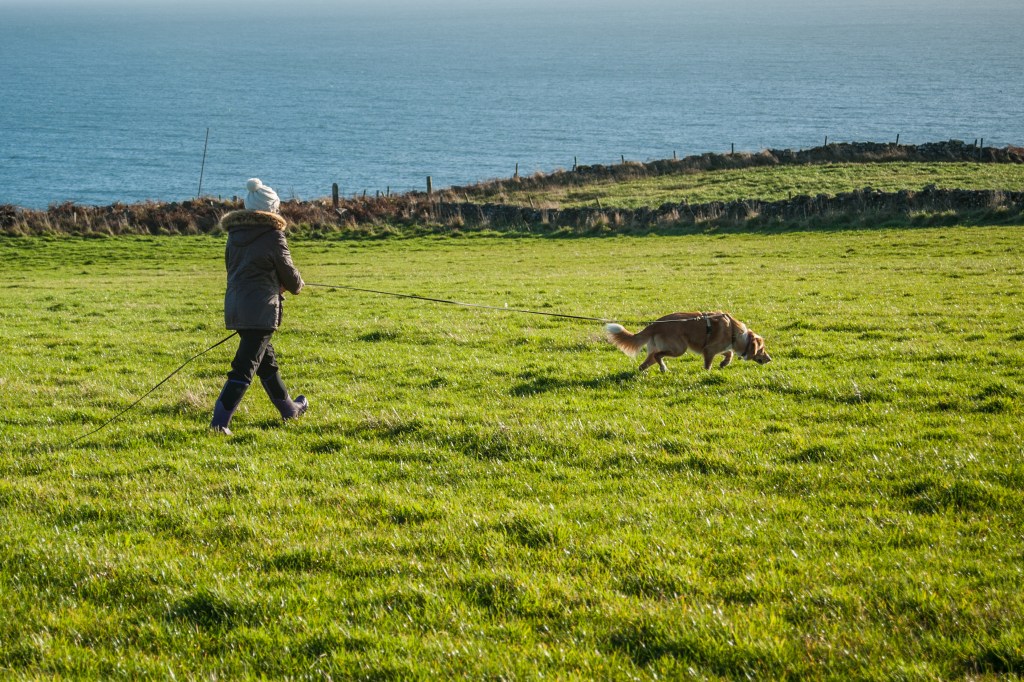
Once Goose had settled, we introduced track trailing as a way to build his confidence. This safe, on-lead activity allowed him to tap into his natural instincts to hunt and follow scents while giving him a structured way to engage with the world around him. Since he was securely on a lead, we didn’t have to worry about his lack of recall, and he absolutely thrived with this newfound job! Watching him follow a trail with excitement and determination was a game-changer in his journey toward confidence.
Step 1: Give Them Time to Decompress
Imagine you just moved to a foreign country where you don’t speak the language, the food is weird, and the locals (that’s you) keep staring at you expectantly. Overwhelming, right? That’s exactly how your rescue dog feels.
Create a quiet, cozy space where they can retreat.
Keep introductions slow—let them come to you instead of overwhelming them with affection.
Stick to a consistent routine to build a sense of security.
Step 2: Build Trust with Positive Reinforcement
Force-free training is the gold standard for gaining a nervous rescue dog’s trust. This means no yelling, no harsh corrections, and definitely no dominance-based techniques. Instead, let’s bribe I mean, motivate them with tasty rewards and praise.
Use high-value treats (think chicken, cheese, or whatever makes their tail wag like a propeller).
Mark and reward calm behaviours if they sit or make eye contact, praise them.
Respect their space forcing interaction can backfire. Let them approach you in their own time.
Step 3: Teach Basic Cues at Home
So, what’s the best way to train my dog at home? Short, positive sessions in a quiet environment. Nervous dogs thrive when they understand what’s expected of them, so start with simple cues.
Sit and Down – These give your dog something to focus on besides their worries.
Touch (target training) – Encourages engagement in a non-threatening way.
Mat training – Teaches them that their bed is a safe, rewarding place.
Step 4: Socialisation—At Their Pace
Rescue dogs often have a history, and we don’t always know the full story. That’s why socialisation should be gentle and gradual.
Start with low-distraction environments before heading to busier places.
Let them observe from a distance before encouraging interaction.
Keep interactions with other dogs and people short and positive.
Step 5: Addressing Fear-Based Behaviours
If your dog reacts nervously (barking, cowering, freezing), resist the urge to punish them. Instead:
Identify triggers and work on desensitisation.
Allow them to retreat from the trigger, build trust and become your dogs ‘safe space’.
Pair scary things with rewards (e.g., if they’re scared of the vacuum, give treats when it’s off and gradually when it’s on).
Use calming tools like snuffle mats, lick mats, or anxiety wraps.
Timing is crucial, contact a professional to help
Step 6: Be Patient, Celebrate Small Wins
Progress won’t always be linear some days, your dog will feel brave, and others, they might regress. That’s totally normal! Celebrate the small victories, whether it’s the first tail wag or finally venturing into the kitchen without hesitation.
Final Thoughts
Learning how to train a rescue dog isn’t about quick fixes it’s about building trust, confidence, and a lasting bond. Force-free training ensures they feel safe while learning the ropes of their new life. With patience, love, and a little humour, your rescue dog will go from nervous newbie to confident companion in no time!
Bonus Tip: If you’re feeling stuck, consider working with a force-free trainer who can offer guidance tailored to your dog’s unique needs. If you’re in Northamptonshire, DogHampton is here to help, just like we helped Goose!🐾
1. It is low impact which is suitable for puppies and dogs of all ages
2. Dogs are on lead, so no embarrassing incidents
3. It’s easy to practice at home, Not much equipment needed
4. Always in small groups.
5. Dogs are worked one at a time so no issues for those that are dog nervous
6. We train in new places every week
7. It’s a great way to build confidence in nervous dogs
8. It helps calm overexcited dogs as they need to concentrate more
9. Fantastic way to build the bond and understanding between dog and handler
Have you heard of Mantrailing before?
Do you think it is only for really sporty dogs and super fit owners?
So here is the truth behind Mantrailing:
It is an exciting new trailing sport where your dog learns to track missing/hidden people based on their unique smell!
Any dog can do this, from small to massive, from young to old, and any breed too!
Even reactive dogs, as we only work one dog at a time and specifically choose the person they are finding to match the dogs personality, it can help improve their confidence immensely.
But I’m not fit enough to do that! We match the length and type of trail to meet your requirements. Trust me I’m no athlete!
My dog has rubbish recall! No worries all dogs are worked on leads so they are under control at all times.
We teach you to work as a team with your dog and help you understand body language and how dogs see our world.
Once you have the basics you can progress through more exciting trails in differing environments, and join in with competitions and fun days or for the more competitive work towards your level 1 certificate!
When it is not your turn to trail you have the opportunity to watch other teams at work which is extremely beneficial for progressing on your journey and understanding of dogs track scent, and the effects of the environment on the trail, after all you are learning too. it is low impact and highly addictive sport that requires concentration from the dog and therefore really helps build focus and can give nervous dogs the chance to build some real self confidence!
So come join us on this highly addictive adventure! Start soon and you may have time to join in the Halloween ghost hunt!!
Have you ever greeted a stranger with a full-on bear hug and maybe a knuckle rub to the head? I hope not!! What would you do if this happened to you?
If your dog’s personality cannot cope with this type of greeting you need to help them. After all if someone greeted your child by hugging them I’m sure they would receive a hostile response from you. Your dog doesn’t need to say hello to everyone.
Meeting face to face is not a natural behavior for dogs, this is the way humans meet each other. Meetings between dogs should be side on with each other.
Never allow your dog to run up to a dog unless the owner has said it’s ok, and even then remember that things can quickly change between dogs.
The Three-Second Rule:
Three seconds is the maximum amount of time the first meeting should last between dogs. This is more than enough time for the dog’s nose to have taken in and processed an immense amount of information. Never pull your dog away as we don’t want either dog thinking there is anything negative about the meeting. A simple ‘this way’ or ‘come on’ maybe showing their ball if they have one.
Many owners make the mistake of waiting that bit longer to see if they ‘get on’ or misreading a ‘freeze’ or other subtle body gestures that mean “I don’t like you furball, leave me alone”!
If you want the dogs to get on. Maybe a walk with friends etc. Wait until they are ignoring each other and then bring them back together for a few more seconds. then repeat again. Watch out for body language when they approach each other to guide you on how your dog is feeling. Body language equivalent
DOG HUMAN EQUIVALENT
Play Bow – Hello would you like to join me for a cup of tea?
Fluid movement – Your pretty I like you
Stiff tails – Have I seen you on crime watch?
Wagging tail – This could go either way. I’m really not sure
Head or paw on the shoulder – Epic Wedgie
Snarl – I want to punch you in the face!
Tail between legs – That bloke scares the bejeezus out of me
Roll onto back – OMG its Fred West
Showing of teeth – Take one step closer and I rain hell on you
Tail wagging can indicate both happy and aggravated, think of an angry cat. A dog can do the same sometimes, you need to look for the rhythm and position of the tail
There are many more body language signals these are just a few, Sign up for one of our courses and we will help you on your journey to speak dog.
I peek out the front door to check on my
dog, who is sunning himself in his favourite spot in the sun. He is lying on an
old moving trolley, since repurposed to give him a boost up to the sunrays,
which don’t reach the ground at this time of morning. As I stick my head out
the door, he lifts his nose, and I can see his nostrils gently flare in and out
as he recognizes I am close. He does not see me with his eyes, as they are
squinted shut due to the sun, but he sees me with his nose.
There are many more examples of my dog
using his nose to see. When I return from the shops, and we greet
enthusiastically, my human tendency is to reach out and touch to say hello, but
he ducks away, preferring to sniff my hands first to see where I have been. (If
you have not already read about the human as opposed to canine perspective of
greeting, it is worth reading ‘How
do you greet a dog politely’). When I return from volunteering at
the dog shelter, he sniffs my shoes and clothes carefully. I get the full pat
down with the nose. If I offer him something, whether it is an object or food,
he does not use his eyes to examine the item further; he sniffs it.
On one occasion, when out on a walk with my
dog, he stopped, hesitant to go further. I surveyed the pavement ahead. It
seemed clear. I thought he was being overly sensitive and encouraged him to
continue. As we passed the parked cars ahead, hiding behind the wheel of the
last car was a cat. I felt very foolish. My dog was right – there was something
ahead! He had seen it with his nose. I should have listened. Being human, I had
immediately dismissed what I could not see with my eyes. On another occasion,
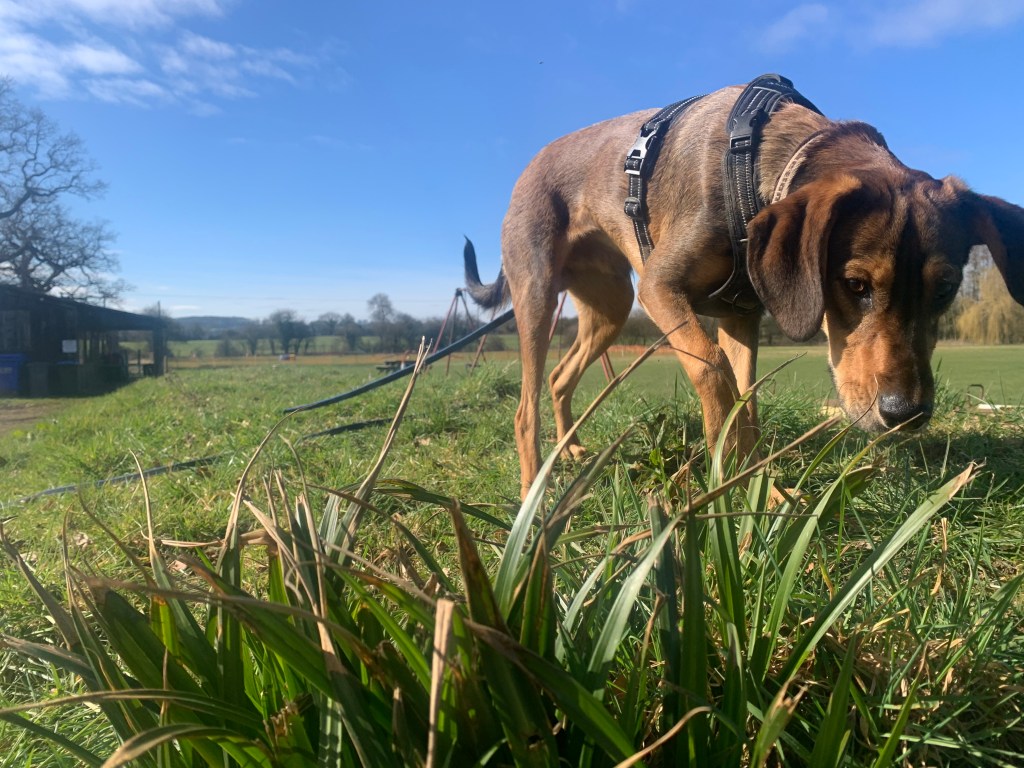
he started sniffing the ground very attentively, seemingly following a trail
back and forth, as he narrowed in on the direction of the scent trail. Looking
ahead to see what had taken his interest, it was easy for me to quickly spot a
scattering of nacho chips that had been discarded on the pavement. This time my
eyesight won out against my dog’s nose, and I was able to divert him away.
Even
with these simple observations, it is apparent how often my dog uses his nose
and scent to make sense of and navigate his environment.
It is understandable why the use of
olfaction may be the predominant sense for dogs. It is estimated that dogs have
300 million olfactory receptor cells; in comparison humans have about 5
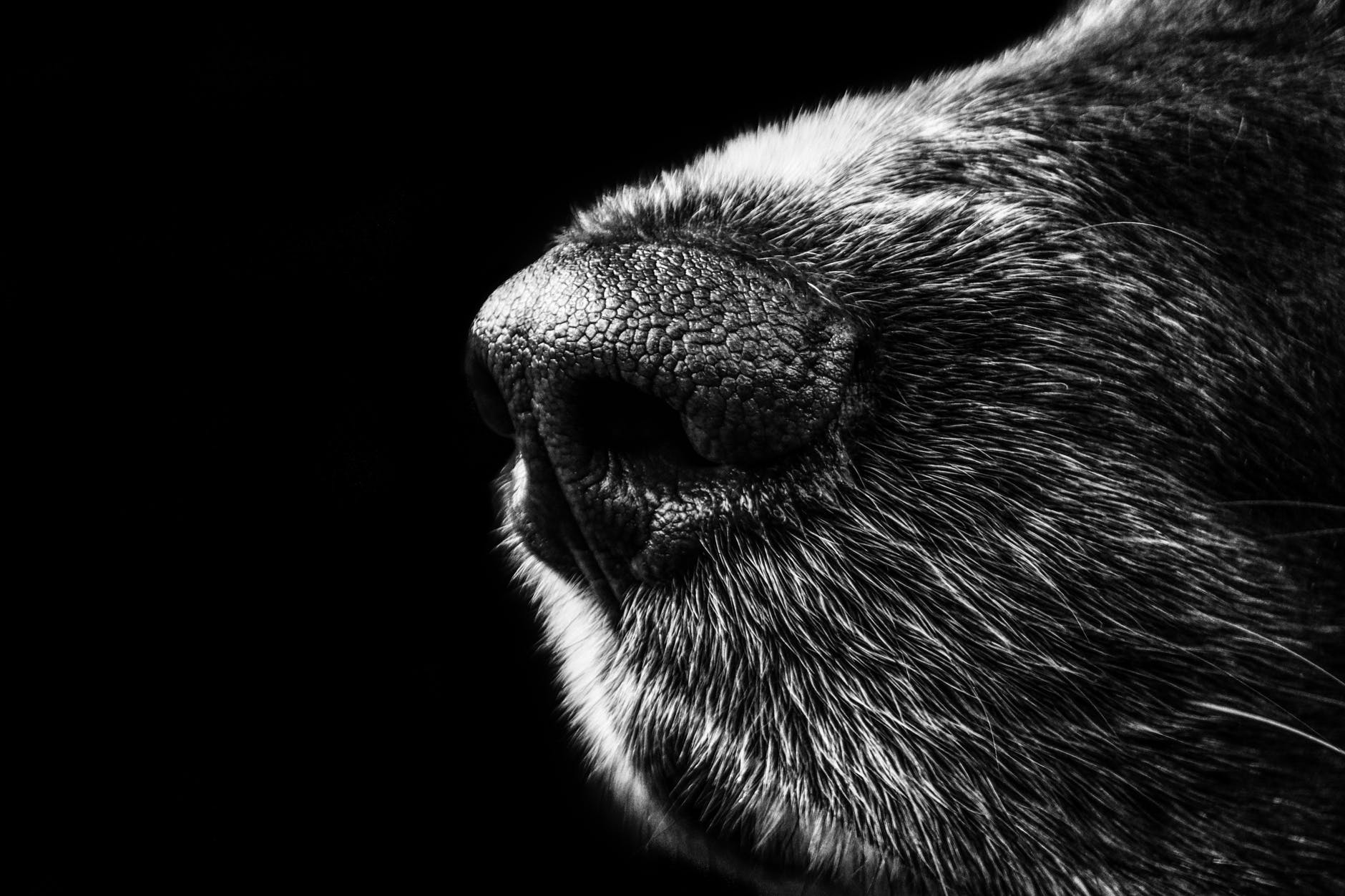
million. Dogs have the ability of smelling with each nostril on an individual
basis, allowing them to distinguish the direction of the scent. The slits on
the side of the nose allow for the old air to exit at the same time as the dog
is breathing in new air through the nostrils, allowing the dog to take in scent
continuously. The air is separated and passes through an area at the back of
the nose that has a labyrinth of scroll-like bony structures called turbinates.
The air is filtered through the turbinates for olfaction, while some of the air
follows a separate route down the pharynx for respiration. The air that humans
take in for respiration and scent is not separated, going in and out with the
air that we smell. Additionally, dogs have a secondary olfactory organ called
the vomeronasal
organ that allows dogs to detect pheromones and non-volatile
chemicals. There are times where you can spot the dog using his vomeronasal
organ, as he will display a tonguing
response. The dog may chatter his teeth or drool a bit at the mouth
as he deciphers the components of the scent. To interpret all this information,
a larger percentage of the dog’s brain is used to process scent, with the
olfactory bulb taking up more area of the brain than it does in humans. The dog
can detect smells at concentrations of 100 million times less than our noses
can detect.
In Alexandra Horowitz’s book, ‘Being a Dog: Following the Dog Into a World
of Smell’, she gives an example of scientific research to test scent
thresholds of detection dogs. One of the tests was how diluted an odour could
become before the dog would struggle to detect the odour. The scent of amyl
acetate (smell of banana) had to be distinguished from non amyl acetate canisters.
The dog kept finding the scent until it was diluted to the equivalent of a
couple of drops of amyl acetate to one trillion drops of water.
It
is estimated that dogs have 300 million olfactory receptor cells; in comparison
humans have about 5 million.
Imagine visiting an art gallery if every time you attempted to look at a
painting, you were forced to move along and had your eyes covered, missing the
chance to get a glimpse of the painting. How frustrating an experience would
that be? As humans, we do not have the same level of perception and therefore
discount dogs’ levels of sensory perception far too many times, especially when
giving them opportunities to interact with the environment. Too often I have
seen guardians impatiently yanking their dogs away if the dog stops to sniff
even for a moment. I have observed dogs that are walked obediently to heel and
not permitted to stray to sniff, dogs walked with equipment that does not allow
them to dip their noses down or move their heads or bodies with ease, or walks
that are carefully curated from a human perspective, where the walk is a quick
march for exercise purposes and stopping is not tolerated. The mental
stimulation from sniffing and exploring can be just as tiring as physical
exercise.
If my dog responds to an environment in a
manner in which he is comfortable to investigate it – in an in-depth manner
with calm sniffing – this indicates that the walk is going well and the
environment is suitable for him. If my dog is pulling, moving erratically and choosing
not to engage with the environment by sniffing, this is a telltale sign that he
is not coping for some reason. So sniffing calmly and engaging with the
environment can give clues as to the internal state of your dog. A good walk
for my dog would be one in which he meanders with a calm, loose, slow-moving
body, taking his time to stop at various spots to sniff and investigate. To do
so, the leash needs to be long enough for him to move comfortably, and the
equipment he is wearing should not hinder him from being able to reach the
ground with his nose easily. The choice of walk should be individual for each
dog; certain environments or times or the duration of a walk can be too
stimulating for some dogs. A dog may not have the appropriate skill level or
coping skills for a particular environment, or the dog’s stress level may be
too high to cope with a particular walk.
How
your dog engages with the environment by sniffing, and in which context he does
so, can give vital clues as to how comfortable your dog is feeling and if he is
coping within an environment.
There is another important reason to pay
attention to your dog’s sniffing. On certain occasions, sniffing plays
a part in how dogs communicate. If you have not already read the dog body
language article about sniffing,
you can read about it here.
The dog may stop to sniff as a calming
signal or negotiation. For example, a dog may use sniffing the
ground at a distance in the beginning stages of approaching another dog. A slow
non-direct approach is polite, and it gives each party the opportunity to
negotiate at a distance. In another context, sniffing could be used as a way to
defuse a situation; one dog may walk away sniffing the ground, encouraging the
other dog to mirror him, defusing the interaction.
Depending on context, sniffing the ground
could also be displacement
behaviour or a stress response. If the dog is unsure of something
ahead, he may slow and start sniffing the ground, showing he may be feeling
conflicted. It is vital to allow your dog to express himself and to observe
your dog’s body language so you can offer support in such situations.
The body language that occurs when a dog
starts sniffing due
to displacement can
be subtle. It is crucial to observe changes in the environment, noting the
dog’s whole body and body posture, as well as movement and body language
signals. For instance, a dog may see something ahead, pause, and then subtly
curve his body away from the object that is causing discomfort. He may then do
some displacement sniffing. It is worth observing how he sniffs; some
displacement sniffing may seem less focused than when a dog is actively
investigating a scent. In other instances, it can seem out of place, as the dog
suddenly finds a spot to sniff intently. The dog may use the moment of sniffing
as a surreptitious way of surveying the environment, so it is important to
observe where the gaze of the eyes falls. The dog may also move his ears,
perhaps to the side slightly, in order to use his other senses to gather
further information. One should pay attention to the subtleties.
Scent is the predominant way in which dogs
make sense of their world. Sniffing is vital to the way dogs gather information
and interact with their environment. At times, depending on the context, a dog
is not just sniffing a scent; he is communicating. What he is communicating can
vary according to the circumstances, so it is worth paying attention in order
to be a supportive partner. Allowing your dog to interact fully with his
environment and express himself with ease ensures a stronger, mutually connected
relationship between dog guardian and dog.
Just 1 more reason to take up Trailing or Tracking with your dog.
The UK as the animal loving nation that is it known for has lead the way in animal welfare changes for the last century, so you would anticipate the statistics regarding animal welfare issues to have decreased with it?. However between 2013 and 2015 3000 people were convicted of animal cruelty but only 7 % of these received a custodial sentence. (RSPCA 2018) in 2018 the RSPCA rescued more than 102900 animals and investigated a total of 130700 cruelty complaints only 1678 of these cases resulted in prosecution. So have the changes in legislation helped pet welfare?
A BBC report
stated that in 2009 Battersea Dogs home euthanized a total of 2815 dogs 1931 of
these for behavioural and temperament issues. BBC (2010),
Are the laws
promoting awareness or are they part of the problem?
As The Animal Welfare Act 2006 now pushes the responsibility for duty of care,
more and more people are seeking the help of ‘professionals’ as the vast
majority of dog owners are aware that training and exercise are vital to ensure
a well balanced happy dog that can be integrated into society.
So why are there so many dogs that need help
with behaviour problems. The canine world is a confusing place, for dogs, owners
and people that work within it. Media ‘experts’ are all over our screens now,
each dishing out their own approach to solving problems. This is still an
unregulated field and there is no single professional governing body to ensure
certain standards are adhered to. In the hands of an inexperienced or misled professional
the very issues the dogs are displaying can become exaggerated to the point the
dog is surrendered and or put to sleep.
Under the Animal Welfare act this ‘professional’ does have an obligation to work within the guide lines of this law. So any walker, pet sitter, trainer or behaviourist that works with a dog has a responsibility for not only the dog, but also its actions whilst under their instruction! They also have a duty of care to ensure the dogs welfare needs are met and that it does not unnecessarilysuffer. While working with a fearful dog if the wrong approach is taken or the correct programme rushed the dog could very likely be subjected to unnecessary suffering in the form of stress or fear, and the ‘professional’ will be held responsible for it. This responsibility reaches further than just the basic needs of the dog. The Control of Dogs Order 1992, states a collar must be worn with adequate detail whilst the dog is in a public place if the dog has no owner details whilst in the custody of a another person then they will be accountable. As is the same under the Dangerous Dogs Act 1991 section 3 clearly states that a dangerously out of control dog in public place is a criminal offence and whomever is in charge of the dog at the time will be deemed accountable for its actions.
“BUT MY DOG WOULDN’T HURT ANYONE” I hear you say and you are probably correct however you need to understand what defines a dog as dangerously out of control. The Control of dogs order defines a dangerously out of control dog as:
A dog
that not just injures someone which you would expect but one that a person has grounds for
reasonable apprehension that it may do so. The implications of this are momentous,
if training or walking a reactive dog a member of the public comes to close and
the dog lunges barking at them even though they have not made contact with that
person and the situation has been controlled very quickly, The dog can still be
reported as it could be deemed to have caused the person a reasonable
apprehension that it may injure them. This could lead to the dog being seized. Even something
as everyday as a dog chasing, barking or jumping up at someone could lead to a
complaint. If the dog happened to break free and injure a member of the public
during a session this would mean the dog may never be returned home to it family
and could very likely be destroyed.
Safety and understanding of the implication of the law need to be the main priority for anyone working with dogs. Ability to interpret canine body language and continually managing the environment you are working within will reduce the risks and likelihood of any incident happening.
Professionals taking money for services from the public have a duty of care not only to ensure they abide by the law but they understand the implication if things go wrong and to also explain and assist you the owner as the same situation could quite easily happen. Did you know that your dog jumping up to say hello could get your lovable pup reported as a dangerous dog more importantly does the person you are paying know!
BBC (2010) Press Office, Available at: http://www.bbc.co.uk (Accessed:
28/05/2019).
RSPCA. (2019) Facts and figures, Available at: http://www.rspca.org.uk (Accessed:
28/05/2019).
the national archives (2019) The Dangerous dogs act 1991, Available
at: http://www.legislation.gov.uk (Accessed: 25/05/2019).


 UK SCENT SPORT