

Based on the research of Lauryn DeGreeff

Mantrailing dogs have long been recognised for their remarkable ability to track human scent over long distances and diverse environments. The core of this ability lies in their sensitivity to volatile organic compounds (VOCs), which are emitted by the human body. Lauryn DeGreeff’s research delves into the chemistry of these VOCs and how they are transported through the environment, providing essential insights into the mechanics of canine olfactory tracking.
The Chemistry of Human VOCs
Human bodies constantly emit a variety of volatile organic compounds through processes such as sweating, respiration, and natural skin exfoliation. These VOCs include acids, alcohols, ketones, and aldehydes, which form a unique olfactory signature detectable by dogs. As DeGreeff’s research reveals, each person’s scent profile is distinct, influenced by genetics, diet, health, and environment. This makes it possible for mantrailing dogs to follow the specific scent of an individual despite competing odors in the environment.
To better understand this, DeGreeff employs headspace sampling and gas chromatography-mass spectrometry (GC-MS) to analyse the chemical composition of human scent. Through this approach, she has identified key VOCs that play a critical role in helping dogs distinguish human odor from background smells.
Vapor Transport Mechanics: How Human Scent Moves Through the Air
Once human VOCs are emitted from the body, they are carried into the environment through a process known as vapor transport. Vapor transport mechanics refer to how volatile compounds behave once they leave their source, in this case, the human body. Several key factors influence how these VOCs move through the air and are detected by dogs.
Temperature
Temperature significantly impacts vapor transport. Higher temperatures can cause human VOCs to evaporate more rapidly, enhancing the scent’s strength and making it easier for dogs to detect in the immediate vicinity. However, this also means that the scent may dissipate more quickly, becoming harder to follow over long distances. Conversely, in cooler temperatures, VOCs may evaporate more slowly but remain closer to the ground, allowing a more sustained scent trail for tracking.
Humidity
Humidity levels influence how long VOCs remain suspended in the air. In high-humidity environments, water vapor can trap VOCs, creating a “cloud” of scent that lingers close to the ground, which is ideal for dogs following a trail. On the other hand, in dry conditions, VOCs are more likely to dissipate quickly, reducing the overall strength of the scent trail.
Wind and Air Currents
Air movement, including wind speed and direction, plays a significant role in the distribution of VOCs. Strong winds can spread scent molecules over a broader area, forcing dogs to use cross-wind search patterns to locate the source of the scent. DeGreeff’s research indicates that experienced dogs are adept at compensating for such environmental factors, adjusting their search strategies to relocate dispersed VOCs.
Surface Interaction
The surface on which a person walks also affects how VOCs are deposited and re-released into the air. For example, porous surfaces like grass and dirt can absorb VOCs, slowly releasing them over time, which creates a more persistent scent trail. In contrast, harder surfaces such as concrete or asphalt may retain less scent, making tracking more difficult for the dog. DeGreeff’s research shows that dogs can still detect residual scents on such surfaces, though it often requires more effort and skill.
How Mantrailing Dogs Detect and Follow Human Scent
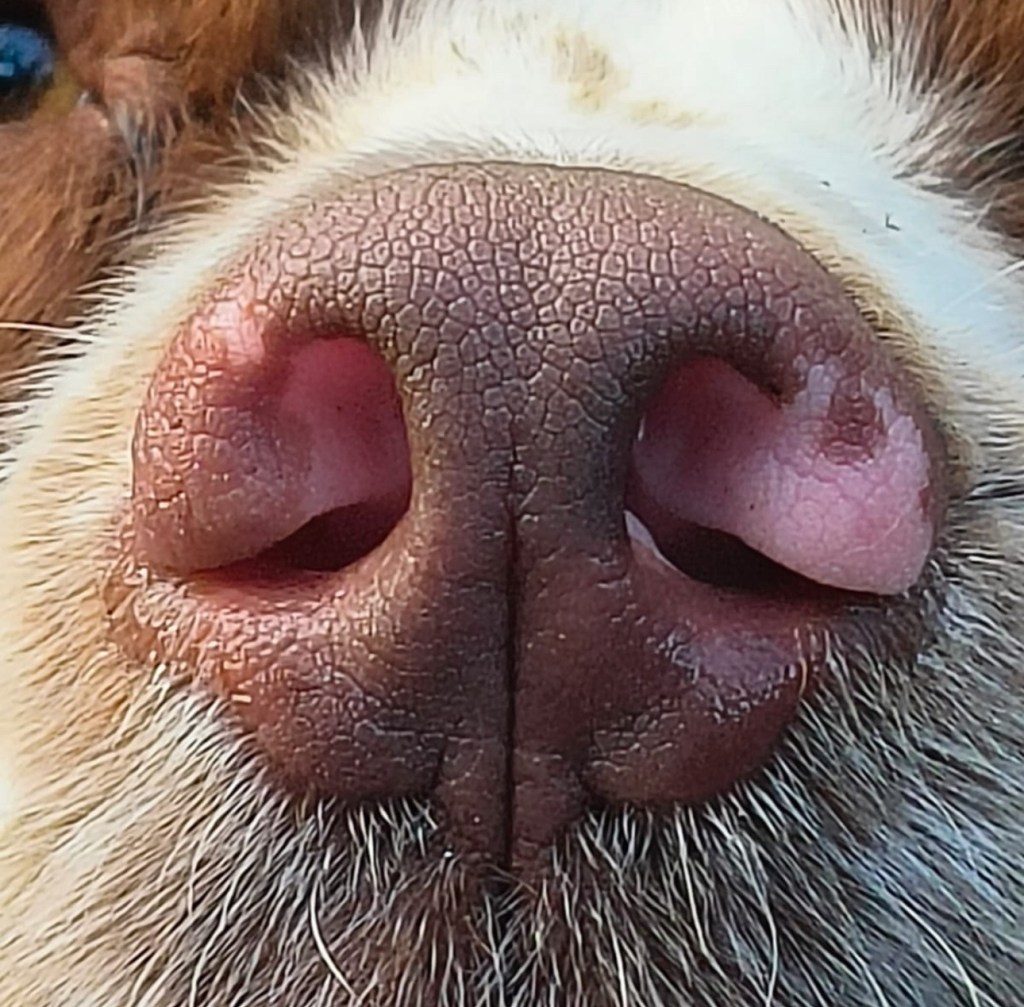
Mantrailing dogs are specially trained to detect the VOCs released by humans and follow the vapor trail, regardless of environmental conditions. Their noses are finely tuned to pick up even the smallest concentrations of VOCs, allowing them to detect scent trails that may be hours or even days old.
DeGreeff’s research highlights that dogs do not simply follow skin flakes or sweat droplets left behind by humans. Instead, they rely on the invisible vapor trail of VOCs that evaporate from a person’s body. This vapor trail is dynamic and interacts with the environment in complex ways, influenced by factors like temperature, wind, and terrain. Mantrailing dogs are trained to process these environmental cues and adjust their behaviour accordingly, making them incredibly effective in tracking over various terrains and conditions.
Human Scent and Thermal Lift
While DeGreeff’s research doesn’t explicitly focus on “thermal lift” as a distinct concept, the idea can be inferred from her studies on how temperature gradients affect vapor transport. Thermal lift occurs when warm air rises, carrying scent molecules upwards, potentially making it more challenging for dogs to detect scent at ground level. This is especially relevant in situations where scent trails may “lift” off the ground and disperse at higher altitudes, causing dogs to lose the scent temporarily. However, experienced dogs often compensate for this by circling back to re-locate the scent at a different elevation.
Synthetic Training Aids and Practical Applications
One of the key contributions of DeGreeff’s research is the development of synthetic training aids that replicate human VOCs. These training aids allow dogs to practice in controlled environments, where the concentration of VOCs can be adjusted to simulate real-world conditions, such as a faint scent trail in a windy or dry environment.
By studying vapor transport mechanics, DeGreeff helps optimise the preparation and usage of these training materials, ensuring they mimic the complex environmental factors dogs will encounter in the field. Her work also emphasises the importance of proper storage and handling of these aids to maintain their chemical integrity over time.
Summary

Lauryn DeGreeff’s research into VOC chemistry and vapor transport mechanics has significantly advanced our understanding of how mantrailing dogs detect and follow human scent. By exploring the interaction between human-emitted VOCs and environmental factors such as temperature, humidity, and wind, DeGreeff’s work helps optimise the training and deployment of these dogs in real-world tracking scenarios. Her insights into vapor transport provide the foundation for improving canine performance, ensuring that mantrailing dogs remain at the forefront of search-and-rescue, law enforcement, and other scent-based detection fields.
In sum, the science behind mantrailing dogs’ success lies not just in their extraordinary olfactory abilities, but also in the nuanced understanding of how human VOCs behave in the natural world—a topic that DeGreeff’s research continues to illuminate.
 UK SCENT SPORT