
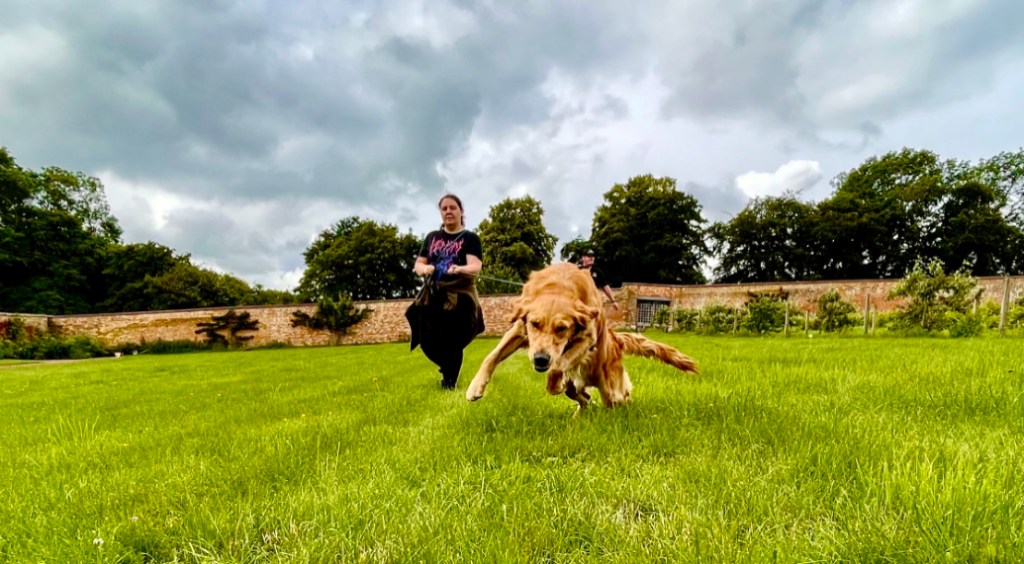
The line we use is the way we communicate to our dogs while they are working: The length between you and your dog needs to be long enough to allow your dog to work to the edges of the scent with minimal hindrance from us. If it is too short (which we see all the time) the dog will not be able to naturally follow the scent and work uninfluenced, too long and you will spend your time untangling it and tripping up your dog.
The tension on the line is so super important, I really cant stress this enough, Lines that drop on the floor with no tension and aren’t looped up quick enough often result in the dog being jerked at a critical point, (most common is after casting at a junction, the dog makes the correct direction choice, heads off quickly full of enthusiasm, reaches the end of the line with a jerk and reads this as a correction or a negative communication, the motivation drops and some dogs who are eager to please their owners will even just head off in the direction the handler is facing whether it is correct or not!
The line should NEVER be used to Influence your dog while they are working. Using the line to direct or guide your dog will simple teach them to rely on you and not their own abilities to follow the scent. Use your words to engage your dog to trail, and be patient, to quote Kevin Kocher
“communicating with your dog through the lead is part of handling a dog. It is what separates a dog handler from a lead holder”.
Don’t be a lead holder! your dog deserves more than that from you!
And finally never underestimate how your position behind your dog can unintentionally influence them on a trail. A line to short and a handler stood or facing to the left in a junction can and often and does encourage the dog to head off in that direction. Patience is the key, always, and I really do mean ALWAYS try to stay directly behind your dog at safe but non hindering distance. Some handlers have a right or left bias, meaning they naturally walk slightly to one side or another, at a greater distance behind your trailing dog this may not be problem, but closer, maybe in a busy town or next to traffic when the line needs to be shorter for safety reasons, this slight bias may make for bad decisions on your dogs part. Dogs are clever at reading us, and taking situational cues we don’t even realize we are showing, this is true in trailing too, as instructors we are very careful not to influence your dogs as we invariably know where the trails go and are very aware that some dogs will pick up on us standing still at a missed turn or moving over to one side or another when a turn approaches.
For the more advanced trailing teams we follow you when you make mistakes and encourage you to ‘have a plan’ and assist you in helping your dog make the right decision.
Some dogs are quick we know this and their directional changes are equally as rapid which will mean the line will end up on the floor, we understand this and totally sympathize with the difficulty as one of our dogs is just the same. The skill you have to practice is a little like cowboy rodeo training, gathering the line in a tidy loop at the same time as staying behind and facing the dog! I’m dizzy just typing this, but it can and must be done to ensure our dogs progress without influence or hindering, so grab your Stetson and get practicing!
 UK SCENT SPORT